

When choosing a security roller shutter, steel door or retractable security grille, it is easy to focus on how substantial the product looks. But appearance alone does not tell you how well a product will resist a determined attempt at forced entry.
This is where LPS 1175 becomes important.
LPS 1175 is a recognised standard for testing the resistance of physical security products to forced entry. Rather than relying on a manufacturer's description of a product as "high security", testing uses defined tools and attack methods to assess its performance.
With LPS 1175 Issue 8, the way security ratings are expressed changed significantly. Instead of simply seeing classifications such as SR1, SR2 or SR3, you may now encounter ratings such as A1, B3, C5, D10 and E10.
So what do these ratings actually mean, and which level of security should you consider?
What Is LPS 1175?
LPS 1175 is a standard covering the testing and certification of intruder-resistant building components and security products.
It is administered through the Loss Prevention Certification Board (LPCB) and can apply to products including:
- Security roller shutters
- Steel security doors
- Retractable security grilles
- Security enclosures and barriers
- Other physical security systems
During testing, specialists attempt to compromise the product using tools associated with the security rating being assessed. The testing is designed to identify the product's minimum resistance to attack rather than simply demonstrating that it can survive a single predetermined test.
This gives architects, contractors, facilities managers, insurers and property owners an independent way of comparing security performance.
LPS 1175 Issue 7 vs Issue 8: What Changed?
If you have previously specified security products, you may be familiar with ratings such as SR1, SR2, SR3 and SR4.
These belong to the Issue 7 rating system.
Issue 8 introduced a more flexible classification system in which the threat/tool category and attack delay are identified separately.
An Issue 8 classification therefore contains two elements:
The letter identifies the threat level/tool category used during testing.
The number identifies the minimum delay, in minutes, associated with the classification.
For example:
D10 = Category D threat/tool level + 10-minute minimum attack delay.
This makes it easier for security professionals to specify protection according to the type of attack anticipated as well as the delay required.
Are Issue 7 and Issue 8 Ratings Directly Equivalent?
This is an important distinction. You will often see products described using terminology such as A1/SR1, B3/SR2, C5/SR3 or D10/SR4 to help customers understand the progression between older and newer security classifications.
However, Issue 7 and Issue 8 ratings should not automatically be treated as direct equivalents.
The testing and classification structure changed under Issue 8, so the individual LPCB certification for a product should always be checked against the requirements of the project.
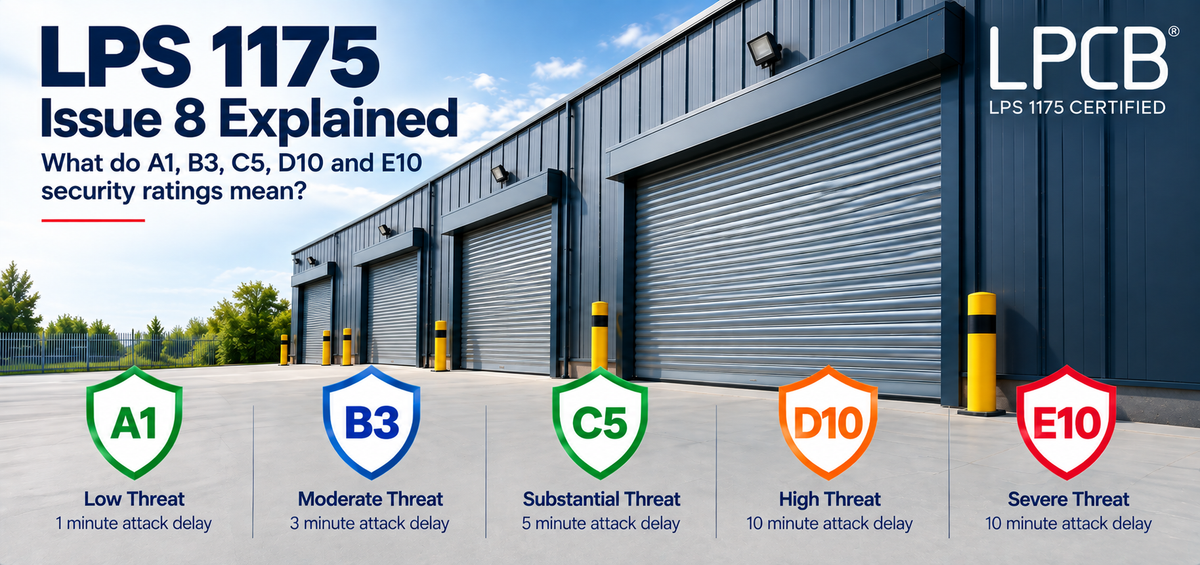
Understanding A1, B3, C5, D10 and E10
At Security Direct, we offer security products covering a range of security requirements, from lower-risk commercial applications through to products intended for significantly higher-risk environments.
Here's a practical overview of the ratings customers are most likely to encounter.
A1 / SR1 – Low Threat
A1 represents an entry point into LPS 1175 Issue 8 certified physical security.
The A represents the relevant tool/threat category, while 1 represents a minimum attack delay of one minute under the defined test conditions.
Products at this level can be appropriate where a risk assessment identifies a relatively low threat but independently tested physical security is still required.
Typical applications can include:
- Lower-risk commercial premises
- Internal security areas
- Offices
- Schools and public buildings
- Some domestic applications
Security Direct offers roller shutters, steel doors and security grilles across this part of the range.
View our A1/SR1 security products
B3 / SR2 – Moderate Threat
Moving up the range, B3 introduces a higher tool category combined with a three-minute minimum attack delay.
This can be appropriate where there is a greater likelihood of a more determined attempt at forced entry.
Applications can include:
- Retail premises
- Offices
- Schools
- Commercial properties
- Light industrial buildings
Security Direct's range at this level includes options across roller shutters, security grilles, steel doors and other physical security products.
The additional resistance can make B3 particularly relevant where a standard security shutter is not sufficient and independently verified attack resistance forms part of the specification.
C5 / SR3 – Medium Threat
C5 combines Category C tools with a five-minute minimum attack delay.
Five minutes may not sound particularly long in everyday terms, but it is important to remember that this refers to working attack time under controlled test conditions, rather than somebody simply standing in front of the product for five minutes.
At this level, Security Direct offers products including the E130 Elite (Lite) Single Skin, P130 Elite (Lite) and i100 Elite roller shutter options, depending on the required configuration.
C5-rated products may be considered for environments where the consequences of unauthorised access are more significant, subject to the project's risk assessment and specification.
View the E130 C5 Security Shutter
D10 / SR4 – High Threat
At D10, both the threat category and resistance period increase substantially.
The classification combines Category D tools with a 10-minute minimum attack delay.
Security Direct identifies higher ratings such as D10 for applications including:
- High-value retail
- Data centres
- Critical infrastructure
- Pharmaceutical sites
- Utility facilities
This is the type of specification where security is generally part of a wider risk-management strategy rather than simply an additional deterrent at a door or window.
Products at this level should therefore be considered as part of the overall security of the building, including the surrounding structure, access control and other protective measures.
E10 / SR5 – Severe Threat
At the upper end of the Security Direct roller shutter range is E10, combining Category E tools with a 10-minute attack delay.
This type of product is intended for demanding applications where a risk assessment establishes the need for substantial resistance to forced entry.
Security Direct currently offers an E130 Security Shutter – E10 (SR5) within its security-rated shutter range.
Potential applications may include high-value and critical sites, but the appropriate rating should always be established by the project's security requirements rather than selecting a product purely because it carries the highest available classification.
Does a Higher LPS 1175 Rating Always Mean a Better Choice?
Not necessarily.
It is tempting to assume that you should simply purchase the highest-rated security product available. In practice, good security specification is about matching the product to the risk.
Factors to consider include:
What is being protected?
How attractive is the property or asset to an intruder?
Where is the building located?
How quickly could an attempted break-in be detected?
Are there alarms, CCTV or security personnel?
What are the insurer's requirements?
What construction will the shutter, grille or door be fixed into?
What does the project's security specification require?
A warehouse storing relatively low-value goods will not necessarily require the same solution as a critical infrastructure facility.
The objective is to create an appropriate level of protection rather than simply choosing the largest number.
Why Attack Delay Matters
One of the useful aspects of Issue 8 is its emphasis on the relationship between threat and delay.
Physical security does not necessarily need to make unauthorised entry impossible indefinitely.
Instead, its role can be to create sufficient resistance and delay for other security measures to become effective.
For example, an attempted break-in may activate an alarm or attract attention. The longer an intruder is required to remain at the building attempting to defeat the physical security, the greater the opportunity for other elements of the security strategy to respond.
This is why roller shutters, doors, grilles, CCTV, alarms, lighting and access control should ideally be considered together rather than in isolation.
LPS 1175 Certification Is About More Than the Shutter Curtain
Another important consideration is that certification relates to the tested product configuration.
A strong shutter curtain fitted poorly into an unsuitable structure will not automatically deliver the performance associated with the certification.
Depending on the product, the tested configuration can include elements such as the curtain or door leaf, guides or frame, locking arrangements, hardware and fixings. Installation and the supporting substrate therefore matter.
Substituting components or failing to follow the manufacturer's installation requirements can compromise security performance.
This is particularly important as security ratings increase.
Which LPS 1175 Rating Do I Need?
There isn't one rating that is right for every building, start with the risk assessment and project specification.
For commercial projects, you should also check whether an insurer, architect, security consultant or other stakeholder has specified a particular standard or rating.
If a specification states LPS 1175 Issue 8 C5, for example, don't assume that any product described simply as "high security" will satisfy that requirement. It's important to check the actual certification.
Likewise, if an older specification refers to an Issue 7 SR rating, don't automatically substitute a newer product based only on an apparent comparison between SR and Issue 8 classifications.
Our team can help identify suitable LPS 1175 security shutters, steel doors and security grilles for the application.
Explore LPS 1175 Issue 7 & Issue 8 Security Ratings
Why Choose an Independently Tested Security Product?
Independent certification provides something that descriptions such as "heavy duty" or "high security" cannot provide on their own: a defined test standard against which the product's resistance has been assessed.
That can be valuable for:
- Demonstrating specified security performance
- Satisfying project requirements
- Comparing suitable security products
- Supporting insurer requirements where LPS 1175 is specified
- Giving architects and contractors clearer specification information
It also makes it easier to build a layered security strategy around a known level of physical resistance.
Frequently Asked Questions
What does LPS 1175 mean?
LPS 1175 is a Loss Prevention Standard used for assessing the resistance of physical security products to forced entry. Products are subjected to manual attack testing using defined tool categories and attack conditions.
What does A1 mean in LPS 1175?
Under Issue 8, the letter identifies the applicable threat/tool category and the number identifies the minimum attack delay. An A1 classification therefore combines Category A with a one-minute delay.
What does C5 mean?
C5 combines the Category C tool/threat level with a five-minute minimum attack delay under the standard's test conditions.
What does D10 mean?
D10 combines the Category D tool/threat level with a 10-minute minimum attack delay.
Is C5 the same as SR3?
You may see C5 and SR3 presented together to help customers navigate Issue 8 and legacy Issue 7 product ranges. However, Issue 7 and Issue 8 use different classification structures and should not automatically be considered directly equivalent. Always check the product's certification and project specification.
Is LPS 1175 only for roller shutters?
No. LPS 1175 applies to a range of intruder-resistant building components and security systems. Security Direct supplies LPS 1175-rated roller shutters, steel security doors and retractable security grilles.
Should I choose the highest security rating available?
Not automatically. The appropriate rating should be determined by the building's risk assessment, the assets being protected, the likely threat, insurer requirements and the wider security strategy.
Need Help Choosing an LPS 1175 Security Rating?
Choosing between A1, B3, C5, D10 and E10 can initially seem complicated, particularly when an existing specification also refers to the older SR rating system.
Security Direct can help you identify an appropriate security-rated roller shutter, steel door or retractable grille based on your project requirements.
Explore our LPS 1175 Issue 7 & Issue 8 range or contact our team to discuss your project.
You can also see what customers say about Security Direct through our Feefo reviews and Trustpilot reviews before ordering.


