

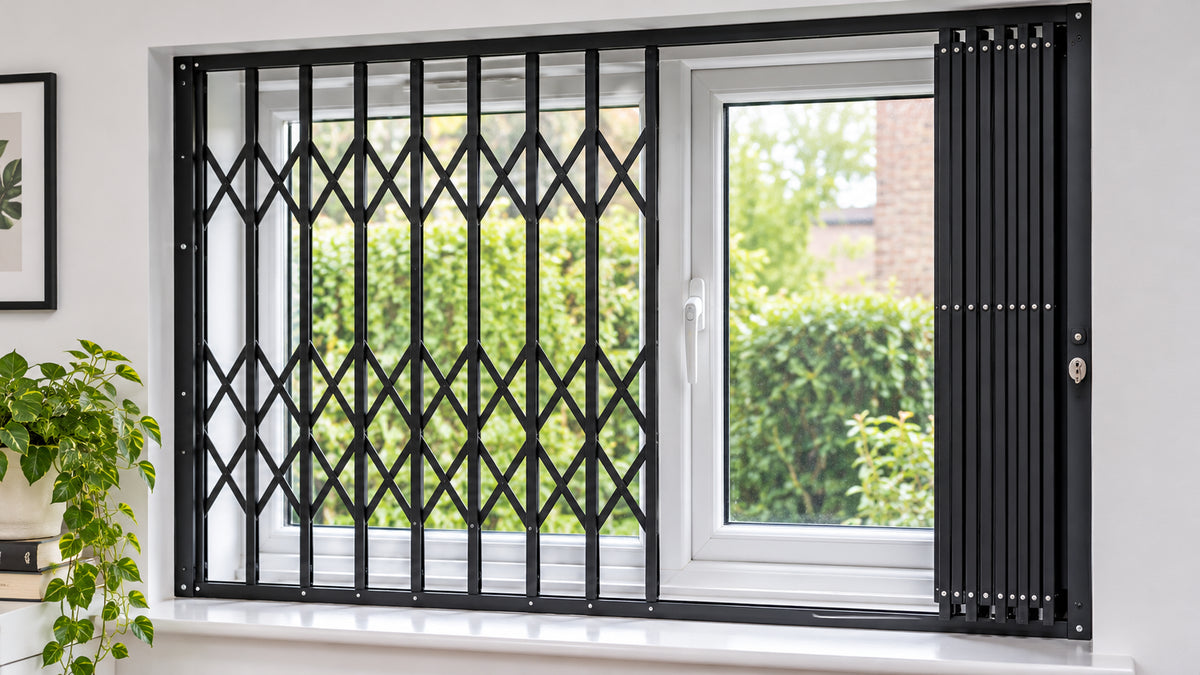
When considering additional security for your home or business, one of the first concerns is often how the product will be installed.
For customers with modern uPVC windows, aluminium frames, timber windows or expensive glazing, the thought of drilling directly into the window frame can understandably be off-putting.
After all, nobody wants to damage their windows, compromise their appearance or risk affecting their performance simply to improve security.
This leads to a common question:
Can security grilles be fitted without drilling into the window frames?
The good news is that, in many situations, security grilles can be installed without fixing directly into the window frame itself.
Depending on the building, the grille design and the surrounding structure, it may be possible to secure the grille to the masonry, structural opening or another suitable supporting surface instead.
However, the most appropriate installation method will depend on several factors, including the type of window, the condition of the surrounding wall and the level of security required.
In this guide, we'll explore how security grilles are fitted, the difference between face fixing and reveal fixing, and what property owners should consider before choosing an installation method.
Do Security Grilles Have to Be Attached to the Window Frame?
No. Security grilles do not necessarily have to be attached directly to the window frame.
In fact, many window security grilles are designed to be fixed to the surrounding building structure rather than the window itself.
This is particularly common with retractable security grilles, which are often installed on the inside of a window opening.
Instead of relying on the window frame to support the grille, suitable fixings can be installed into the surrounding masonry or other structurally appropriate surfaces.
This can help preserve the window frame while providing a secure mounting point for the grille.
It is important to remember, however, that not every wall or window opening is suitable for the same fixing method.
The installation must be designed around the actual construction of the building.
What Is Face Fixing for Security Grilles?
Face fixing is a common method of installing window security grilles.
With this arrangement, the grille is positioned against the face of the wall surrounding the window opening.
The fixing points are generally located outside the clear opening, allowing the grille to cover the window while being secured to the surrounding structure.
For example, an internally fitted retractable grille may be installed against the wall around a window rather than being attached to the window frame.
This can be particularly useful where the window frame is unsuitable for drilling or where the customer wishes to avoid modifying it.
Benefits of Face-Fixed Security Grilles
One advantage of face fixing is that it may allow the grille to be installed independently of the window frame.
It can also provide flexibility when positioning the grille, particularly where there is sufficient wall space around the opening.
For retractable security grilles, the available wall space can influence how the grille is positioned and where the folded grille is stored when open.
However, face fixing isn't suitable for every installation.
The wall must provide an appropriate fixing substrate, and sufficient space must be available for the grille and its operating components.
The installer will also need to consider whether the chosen fixing arrangement is compatible with the security performance required.
What Is Reveal Fixing for Security Grilles?
Reveal fixing is another installation method commonly used for window security products.
The reveal is the recessed area between the face of the wall and the window frame.
With reveal fixing, the grille is installed within the window opening, with fixings secured into suitable surfaces around the sides, top or bottom of the reveal, according to the product's design.
This can create a neat appearance because the grille sits within the opening rather than projecting across the surrounding wall.
It may also be useful where there is limited wall space around the window.
However, the available reveal depth is important.
There must be enough room to accommodate the grille, its tracks or guides, and any moving components without interfering with the window.
Does Reveal Fixing Mean Drilling Into the Window?
Not necessarily.
A reveal-fixed security grille may be secured into the surrounding masonry rather than the window frame.
However, some openings have limited structural material available, particularly where the window frame occupies much of the reveal.
The installer must establish whether there is a suitable fixing surface before recommending this method.
Can Security Grilles Be Installed Around uPVC Windows?
Yes, security grilles can often be installed around uPVC windows without drilling directly into the uPVC frames.
This is one reason internal retractable security grilles can be an attractive option for properties with modern replacement windows.
uPVC window frames are designed as part of a complete window system, and unnecessary modifications can affect their performance.
Drilling into a frame may also raise questions about manufacturer warranties, depending on the window supplier's terms.
By fixing the security grille to suitable surrounding masonry or another approved structural surface, it may be possible to avoid altering the window frame.
However, the installer must still consider the position of window handles, opening casements, trickle vents and any other components that need to remain accessible.
A grille that protects the window but prevents it from opening or operating correctly may not be suitable for the intended application.
What About Aluminium and Timber Window Frames?
The same general principles apply to aluminium and timber windows.
Aluminium frames are frequently used in commercial buildings, offices and modern developments.
Although aluminium can be strong and durable, this does not mean that every aluminium window frame is suitable for supporting a security grille.
The frame's design, connection to the building and manufacturer's guidance must all be considered.
Timber frames present different considerations.
Older timber windows may have decorative features, historic significance or areas affected by wear and deterioration.
In these situations, avoiding direct fixings into the window frame may be particularly desirable.
For both aluminium and timber windows, the surrounding structure may offer an alternative fixing location, provided it is suitable for the proposed grille.
Can Retractable Security Grilles Be Fitted Without Damaging Existing Windows?
In many cases, yes.
Retractable security grilles are particularly useful where customers want additional protection without permanently covering their windows.
Unlike fixed window bars, retractable grilles can be opened and folded back when security protection is not required.
This allows customers to retain access to their windows and enjoy a more open appearance during normal use.
Many retractable systems can be installed independently of the window frame, depending on the available fixing surfaces.
For example, an internal grille may be positioned across a window opening and secured to suitable surrounding masonry.
When closed, the grille provides a physical security barrier.
When open, it folds back to one side or, with certain configurations, both sides of the opening.
The amount of space required for stacking will depend on the grille model and the dimensions of the opening.
You can explore the available options in our Security Grilles collection.
Can Security Grilles Be Installed Without Any Drilling?
This is an important distinction.
Installing a security grille without drilling into the window frame is not the same as installing one without drilling at all.
Most conventional security grilles require secure mechanical fixings to an appropriate supporting structure.
These fixings are essential because the grille must remain attached to the building when subjected to the forces it is intended to resist.
A grille that is simply wedged into an opening or attached using unsuitable adhesive fixings may not provide reliable security.
There may be specialist applications where alternative engineered mounting arrangements are possible, but these should not be assumed to be suitable for ordinary window security grilles.
For most installations, the objective is therefore to avoid unnecessary drilling into the window itself while still achieving secure attachment to the building.
Why the Surrounding Wall Matters
The strength of a security grille installation depends on more than the grille itself.
The surrounding structure and the quality of the fixings are equally important.
A strong steel grille installed into weak or deteriorating masonry may not provide the level of protection expected.
Different building materials require different fixing approaches.
For example, solid brickwork, concrete and structural steel may provide suitable fixing opportunities when assessed correctly.
By contrast, plasterboard, damaged brickwork, lightweight blockwork and some cavity-wall constructions may require additional consideration or a different mounting arrangement.
The condition and construction of the substrate must be checked before installation.
This is especially important where a customer requires a particular security rating.
What If You Need LPS 1175-Rated Security Grilles?
For customers seeking higher levels of protection, independently tested security grilles may be appropriate.
LPS 1175 is a recognised standard used to assess the resistance of security products to defined forced-entry attacks.
Products tested to this standard are assessed against specified attack tools and resistance times.
However, an independently tested grille does not automatically provide the same level of protection regardless of how it is installed.
The fixing arrangement, supporting structure and installation method must be consistent with the product's approved specification and relevant certification requirements.
This means an installer cannot simply substitute different fixings or move the grille to an unsuitable surface and assume the original rating still applies.
If you're considering a security-rated grille, it's important to establish whether the proposed installation method is covered by the manufacturer's approved details.
For more information, read our guide to LPS 1175 Issue 7 and Issue 8 testing.
Can Security Grilles Be Fitted in Listed Buildings?
Listed buildings and properties with historic features require particular care.
Owners may wish to improve security without altering original timber windows, decorative stonework or other significant architectural features.
An internally fitted security grille may sometimes offer a less visually intrusive solution than an external product.
However, this does not automatically mean the installation can proceed without consent.
Fixing a grille into historic masonry, plasterwork or other protected building fabric may still constitute an alteration requiring listed building consent.
The need for consent depends on the property and the proposed works.
Before installing security grilles in a listed building, seek advice from the local planning authority or conservation officer.
Where appropriate, a specialist installer should work with the property owner to explore installation methods that minimise unnecessary alterations.
Will Security Grilles Affect How My Windows Open?
This depends on the grille design and its position.
An internally fitted security grille must be positioned so that it does not unnecessarily interfere with window handles, opening mechanisms or ventilation.
For example, an inward-opening window may require more clearance than an outward-opening casement.
Retractable security grilles can provide flexibility because they can be opened when access to the window is needed.
However, the grille's stacking arrangement, tracks and locking points must still be considered.
The installation should also be assessed against any relevant emergency escape requirements.
A window that forms part of an escape route must not be obstructed by a grille that prevents occupants from escaping safely.
Where emergency egress is required, the suitability of the grille and its release arrangement should be assessed as part of the building's fire safety strategy.
Is Face Fixing or Reveal Fixing Better?
There is no single installation method that is best for every property.
Face fixing may be suitable where there is adequate wall space around the opening and an appropriate supporting structure.
Reveal fixing may offer a neater installation where the window opening has sufficient depth and suitable fixing surfaces.
The choice depends on the building, the grille design, the available space and the required security performance.
A professional assessment can help determine which arrangement is most appropriate.
| Consideration | Face fixing | Reveal fixing |
| Typical position | Across the wall face around the opening | Within the recessed window opening |
| Window frame drilling | Often avoidable | Often avoidable |
| Space required | Suitable wall area around the opening | Sufficient reveal depth and fixing surfaces |
| Appearance | Grille sits across the surrounding wall | Grille sits within the opening |
| Main consideration | Wall condition and fixing positions | Reveal dimensions and substrate suitability |
Both methods can be effective when the product and installation are correctly specified.
What Should You Check Before Ordering Security Grilles?
Before purchasing window security grilles, it's worth gathering some basic information about the opening.
Start by measuring the approximate width and height of the window, including any surrounding wall space that may be available for installation.
Consider whether the window opens inwards or outwards and whether there are handles, vents or other features that could interfere with the grille.
It is also useful to identify the wall construction where possible.
Photographs showing the full window opening and surrounding wall can help a supplier understand the proposed installation.
If avoiding drilling into the window frame is a priority, explain this at the enquiry stage.
This allows the supplier to assess whether face fixing, reveal fixing or another approved arrangement may be suitable.
For security-rated products, make sure the proposed installation is compatible with the required certification.
Frequently Asked Questions About Security Grille Installation
Can you install security grilles without drilling into uPVC windows?
Yes, in many cases security grilles can be fixed to suitable surrounding masonry or another structural surface rather than directly into the uPVC frame. The available fixing points must be assessed before installation.
Do security grilles damage window frames?
Not necessarily. Where a grille is installed independently of the window frame, direct drilling into the frame may be avoided. However, the installation will usually require secure fixings into the surrounding building structure.
Can retractable security grilles be fitted inside a window recess?
Yes, some retractable security grilles can be installed within a window reveal, provided there is sufficient space and a suitable supporting structure.
Can security grilles be installed without drilling any holes?
Most conventional security grilles require mechanical fixings. A no-drill installation should not be assumed to provide suitable security unless it forms part of a properly engineered and approved system.
Can security grilles be fitted to plasterboard walls?
Plasterboard alone should not be assumed to provide a suitable fixing substrate for a security grille. The installer may need to locate an appropriate supporting structure or specify another mounting arrangement.
Can I fit security grilles myself?
Some security products may be supplied for self-installation, but the fixing method must follow the manufacturer's instructions. For security-rated grilles or installations involving uncertain substrates, professional advice is particularly important.
Do security grilles stop windows from opening?
Not necessarily. Retractable grilles can be opened to provide access to the window, although their position and operation must be considered during installation.
Can security grilles be fitted to listed buildings?
Potentially, but listed building consent may be required, even for internal installations. Advice should be obtained before altering historic building fabric.
Protect Your Windows Without Unnecessary Alterations
Improving window security doesn't always mean drilling into expensive or carefully maintained window frames.
In many situations, security grilles can be installed using suitable fixing points in the surrounding building structure, allowing the existing window frame to remain untouched.
Whether face fixing or reveal fixing is more appropriate will depend on the building construction, window design, grille type and level of protection required.
The key is to select a system that provides effective security while respecting the practical requirements of the property.
At Security Direct, we offer a range of security grilles for domestic, commercial and industrial applications, including retractable and independently tested security options.
If you're considering window security grilles but are concerned about drilling into existing frames, our team can help you explore the available options.
Browse our Security Grilles collection or contact Security Direct to discuss your window dimensions and installation requirements.
You can also explore our Security Grille Buyers Guide for further information.
Before making a decision, you can read customer experiences on our Feefo review page and Trustpilot.


