

Fire Safety (England) Regulations 2022
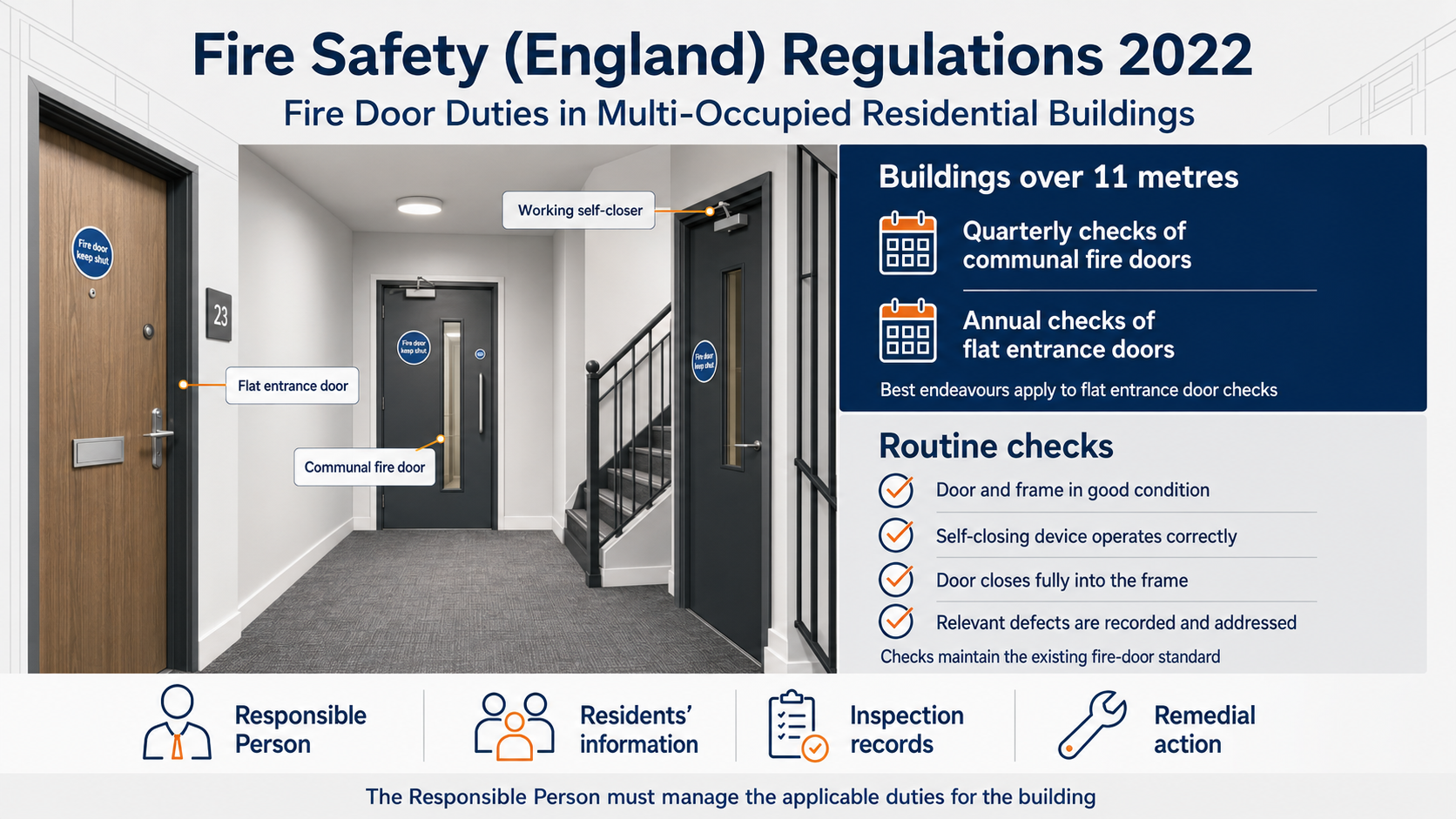
The Fire Safety (England) Regulations 2022 strengthen fire safety requirements in multi-occupied residential buildings in England.
They sit alongside:
- The Regulatory Reform (Fire Safety) Order 2005
- The Fire Safety Act 2021
These regulations place specific legal duties on Responsible Persons, particularly regarding fire doors.
Who Do the Regulations Apply To?
The Regulations apply to:
- Multi-occupied residential buildings in England
- Buildings containing two or more domestic premises
- Blocks of flats
Additional duties apply to buildings:
- Over 11 metres in height
- Over 18 metres in height
This page focuses specifically on the implications for fire doors and shutters.
Fire Door Duties – Buildings Over 11 Metres
For residential buildings over 11m in height, Responsible Persons must:
Undertake Quarterly Checks of Communal Fire Doors
This includes:
- Doors in corridors
- Stairwells
- Plant rooms
- Service risers
Checks must confirm:
- Doors close fully and latch
- Seals are intact
- Hinges and hardware are secure
- No visible damage affecting performance
Annual Checks of Flat Entrance Doors
Flat entrance doors (front doors to individual apartments) must be checked:
- On a “best endeavours” basis
- At least once every 12 months
This requirement was introduced following clarification that flat entrance doors fall within the scope of fire safety legislation.
What About Fire Shutters?
While the Regulations specifically highlight fire doors, the overarching duty under the Fire Safety Order still applies.
If fire shutters form part of the building’s compartmentation or escape protection strategy, they must be:
- Maintained in efficient working order
- Inspected at appropriate intervals
- Tested for correct automatic deployment
Neglecting fire shutters can compromise compartmentation in commercial or mixed-use buildings.
What Must Be Checked?
Typical inspection points include:
- Self closing function
- Door alignment
- Gaps between leaf and frame
- Condition of intumescent and smoke seals
- Glazing integrity (where applicable)
- Operational hardware
- No unauthorised modifications
For shutters:
- Activation systems
- Fusible links (if applicable)
- Motor and control function
- Obstructions
- Drop test verification (where required)
Record Keeping Requirements
Responsible Persons must:
- Keep records of inspections
- Record defects identified
- Record remedial actions taken
- Retain documentation as part of fire safety management
Documentation may be requested during enforcement visits.
Why These Regulations Matter
The Regulations were introduced to:
- Improve accountability in residential buildings
- Prevent compartmentation failure
- Ensure ongoing inspection of critical fire doors
- Address issues highlighted by high-rise residential fire incidents
They shift fire door management from “best practice” to legal obligation.
Common Compliance Risks We See
- No documented inspection regime
- Fire doors wedged open
- Failed closers not replaced
- Missing smoke seals
- Flat entrance doors replaced without certification
- Fire shutters not included in maintenance schedules
All can create enforcement and liability risks.
Relationship to Other Fire Standards
The Regulations do not replace testing standards.Fire doors and shutters should still comply with:
- BS EN 1634-1 (Fire resistance)
- BS EN 1634-3 (Smoke leakage)
- BS EN 16034 (Product standard)
- Approved Document B (Design stage guidance)
The 2022 Regulations focus on inspection and ongoing management, not product testing.
Who Is the “Responsible Person”?
Usually:
- The freeholder
- The building owner
- The managing agent
- A Right to Manage company
They carry legal responsibility for compliance.
Need Help with Fire Door Compliance?
If you manage or own:
- Residential blocks
- Mixed use developments
- High rise buildings
- Commercial buildings with communal areas
We can provide:
- Scheduled fire door inspections
- Remedial works
- Fire shutter testing and servicing
- Compliance documentation support
Contact us to discuss a structured inspection programme.
Frequently Asked Questions
Who is legally responsible under the Fire Safety (England) Regulations 2022?
Who is legally responsible under the Fire Safety (England) Regulations 2022?
The legal duty falls on the Responsible Person, typically:
- The building owner
- The freeholder
- The managing agent
- A Right to Manage (RTM) company
They are responsible for ensuring required fire door inspections are carried out and recorded.
How often must communal fire doors be checked?
How often must communal fire doors be checked?
In residential buildings over 11 metres in height, communal fire doors must be inspected at least every three months (quarterly).
This includes doors in:
- Corridors
- Stairwells
- Plant rooms
- Service risers
The inspection must confirm that doors are functioning correctly and free from defects.
Do flat entrance doors have to be inspected as well?
Do flat entrance doors have to be inspected as well?
Yes.
For buildings over 11 metres, flat entrance doors must be checked at least once every 12 months, on a “best endeavours” basis.
This means the Responsible Person must take reasonable steps to gain access and carry out the inspection.
What should be checked during a fire door inspection?
What should be checked during a fire door inspection?
Inspections should confirm:
- The door self-closes fully and latches
- Seals are present and undamaged
- Hinges and hardware are secure
- Gaps are within acceptable tolerances
- No unauthorised alterations have been made
Any defects must be recorded and remedied promptly.
Do the Regulations apply to fire shutters as well?
Do the Regulations apply to fire shutters as well?
The Regulations specifically reference fire doors, but under the broader Fire Safety Order, any fire-resisting element — including fire shutters — must be maintained in efficient working order.
If shutters form part of compartmentation or escape protection, they should be included in the building’s inspection and maintenance regime.


