

LPS 1175 Issue 7 & Issue 8
When specifying high-security steel doors, roller shutters or security grilles, one of the most recognised UK standards is LPS 1175.
Developed by the Loss Prevention Certification Board (LPCB), LPS 1175 sets out independent testing requirements for physical security products designed to resist forced entry.
If you are protecting:
- Commercial premises
- Schools and public buildings
- Warehouses and industrial units
- High-value retail
- Critical infrastructure
- Domestic properties
Understanding LPS 1175 ratings is essential.
LPS 1175 Issue 7 vs Issue 8
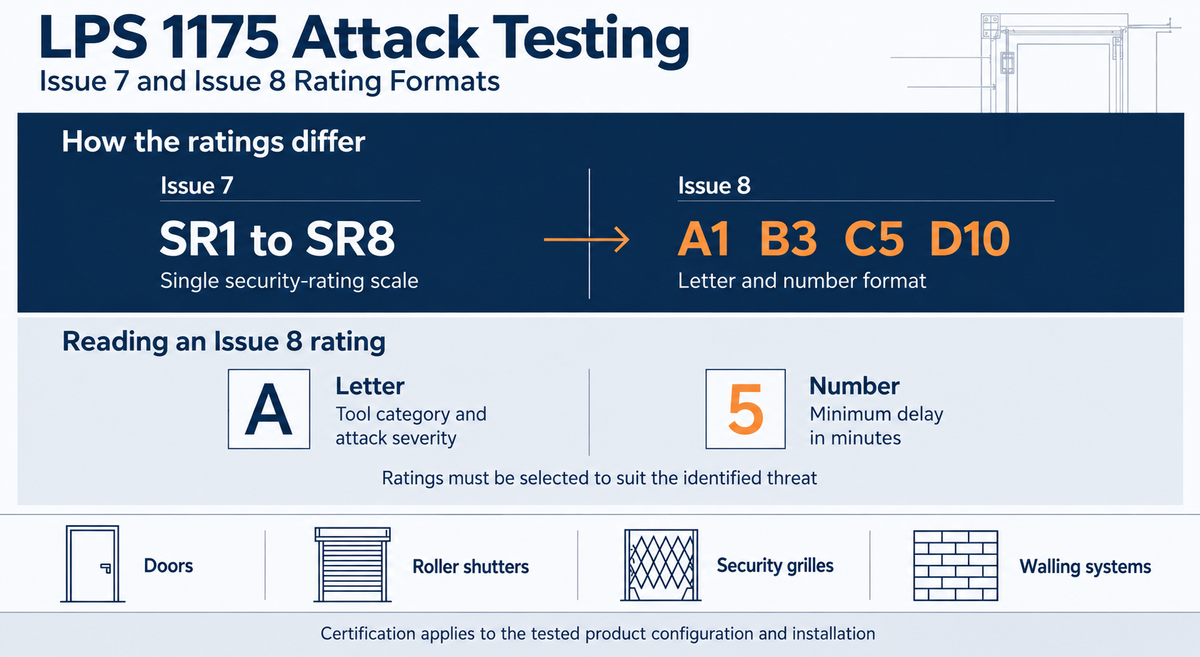
LPS 1175 Issue 8 introduced a significant change to the way security performance is classified. Under Issue 7, products were assessed using a linear Security Rating system, commonly shown as SR1 through to SR8. As the Security Rating increased, so did the severity of the tools, techniques and attack conditions used during testing. While these ratings became widely recognised by architects, insurers and security professionals, the system provided less flexibility when specifying different combinations of attack tools and resistance times.
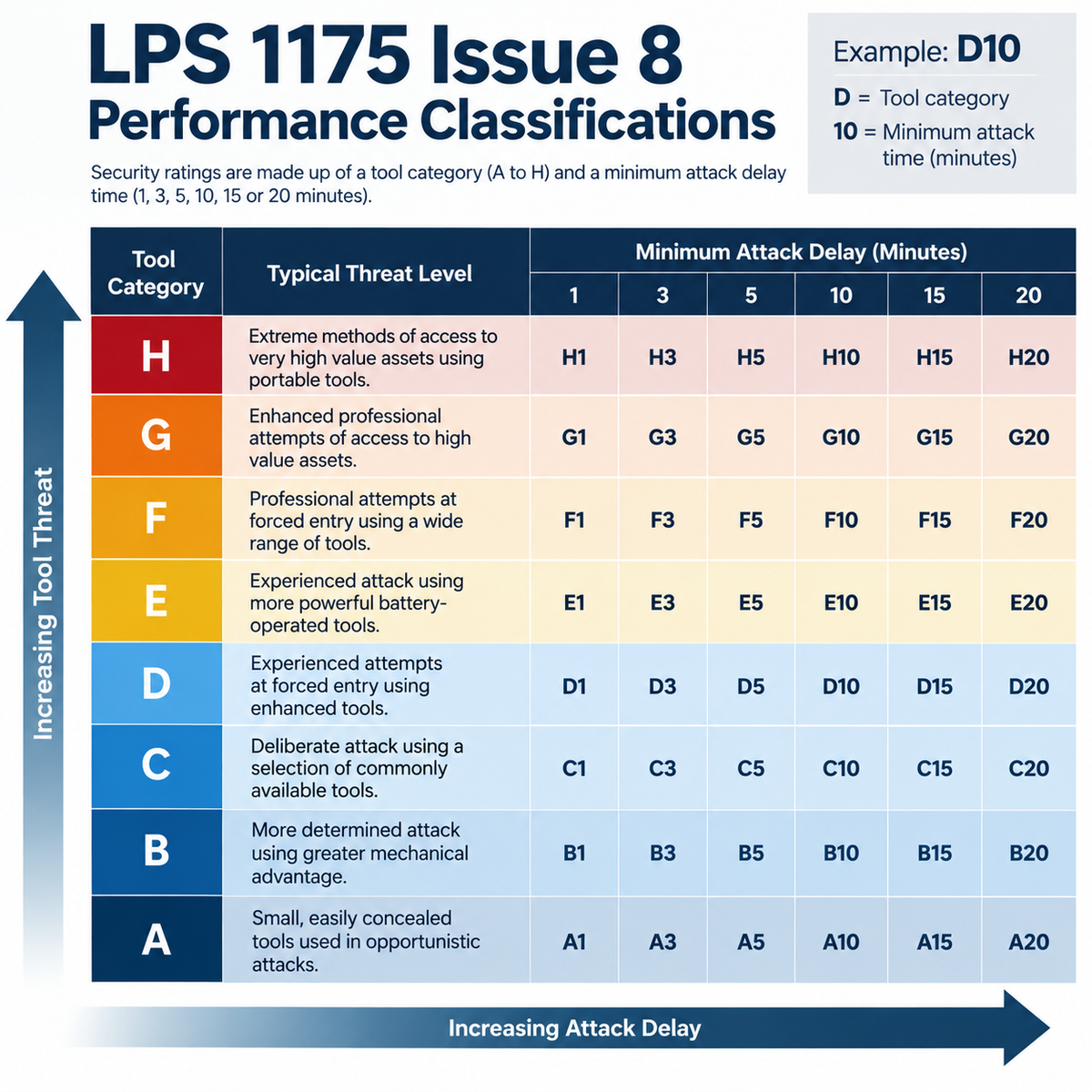
With Issue 8, the classification system separates the tool category from the minimum attack delay. Ratings use a letter from A to H to identify the category of tools used during testing, followed by a number: 1, 3, 5, 10, 15 or 20 each representing the minimum attack time in minutes. For example, a D10 security rating means the product has been tested against Category D tools with a minimum attack resistance of 10 minutes. This provides a more detailed and transparent way of specifying security performance.
Issue 8 also updated the testing methodology to better represent modern methods of forced entry. Tool categories were revised to include more realistic equipment, including modern cordless drills, improved cutting tools and updated impact tools. Tool sizes, weights and maximum tool-set weights were also reviewed to improve the consistency and realism of testing. The previous D+ category was replaced by Category E, forming part of the expanded A–H classification structure.
Important: Issue 7 and Issue 8 ratings should not automatically be treated as direct equivalents. Products may carry both legacy SR classifications and Issue 8 ratings depending on their certification. Always check the individual product's LPCB certification and the requirements of your project specification.
Key Details of LPS 1175 Issue 7 & Issue 8
Typical Applications by Rating Level
Typical Applications by Rating Level
While exact specification depends on risk assessment, broadly:
Lower Ratings (e.g., SR1 / A1)
- Low-risk commercial premises
- Internal security doors
- Roller shutters, steel doors and security grilles available in this rating.
Mid-Level Ratings
(e.g, B3/SR2 & C5/SR3)
- Schools
- Retail
- Offices
- Light industrial
- Roller shutters, steel doors and security grilles available in these ratings.
Higher Ratings
(e.g, D10/SR4 & E10/SR5)
- High-value retail
- Data centres
- Critical infrastructure
- Pharmaceutical sites
- Utility facilities
- Roller shutters and steel doors available in these ratings.
Security specification should always follow a risk assessment.
What Does LPS 1175 Testing Involve?
What Does LPS 1175 Testing Involve?
Products are subjected to independent testing compromising of:
- Repeated physical attack
- Defined tool sets (e.g., screwdrivers, crowbars, grinders depending on rating)
- Time-based resistance measurement
- Attack against weak points
- Assessment of hardware, frame and fixings
Testing is not limited to the door leaf, the complete assembly is evaluated.
LPS 1175 and Insurance Requirements
LPS 1175 and Insurance Requirements
Many insurers recognise LPS 1175 certification. In some cases, insurance policies may:
- Require a minimum SR rating
- Specify LPCB-approved products
- Require third-party certification
Using uncertified products may invalidate insurance compliance.
Installation Matters
Installation Matters
Certification applies to the tested configuration.
Security performance can be compromised by:
- Incorrect installation
- Substituted hardware
- Inadequate fixing into weak substrates
- Poor frame anchoring
Installation must follow manufacturer guidance and tested conditions.
Does LPS 1175 certification apply to the door leaf only?
Does LPS 1175 certification apply to the door leaf only?
Certification applies to the tested configuration.
Security performance can be compromised by:
- Incorrect installation
- Substituted hardware
- Inadequate fixing into weak substrates
- Poor frame anchoring
Installation must follow manufacturer guidance and tested conditions.
Common Mistakes We See
Common Mistakes We See
- Specifying outdated Issue 7 ratings when Issue 8 applies
- Assuming higher steel thickness automatically means higher rating
- Ignoring frame and locking system requirements
- Not matching rating to actual risk level
- Installing high-rated doors into weak surrounding structure
Security is only as strong as the full installation.
If you have any questions, please don't hesitate to contact our team.


Frequently Asked Questions
What is the difference between LPS 1175 Issue 7 and Issue 8?
What is the difference between LPS 1175 Issue 7 and Issue 8?
Issue 7 used the older SR1–SR8 rating system.
Issue 8 introduced a new classification format using letter and number combinations (e.g. B3, C5, D10).
Issue 8 provides clearer alignment with tool categories and attack durations and reflects modern forced-entry methods. It is now the current standard.
Is Issue 7 still valid, or do I need Issue 8 certification?
Is Issue 7 still valid, or do I need Issue 8 certification?
Issue 8 is the current version of the standard.
While some products may still carry Issue 7 certification, most new specifications and insurers expect Issue 8 compliance. Always check the project specification or insurance requirements before procurement.
For new installations, Issue 8 is generally recommended.
What do the letters and numbers mean under Issue 8?
What do the letters and numbers mean under Issue 8?
Under Issue 8:
- The letter (A–H) represents the category of tools used during testing.
- The number indicates the attack resistance duration and severity level.
Higher classifications indicate greater resistance to forced entry.
Specification should match the building’s risk profile, not simply aim for the highest rating.
Does LPS 1175 certification apply to the door leaf only?
Does LPS 1175 certification apply to the door leaf only?
No.
LPS 1175 certification applies to the complete assembly, including:
- Door leaf
- Frame
- Locks and hardware
- Fixings
- Glazing (if applicable)
Substituting components or installing incorrectly can invalidate the security rating.
How do I know which LPS 1175 rating I need?
How do I know which LPS 1175 rating I need?
The appropriate rating depends on:
- The building’s risk level
- Value of assets inside
- Location and crime profile
- Insurance requirements
- Type of occupancy
For example:
- Schools and offices may require mid-level ratings
- High-value retail or infrastructure sites may require higher classifications
A proper risk assessment should guide specification.
What is LPCB Certification?
What is LPCB Certification?
LPCB stands for Loss Prevention Certification Board. It is an independent certification body that tests and certifies security and fire protection products against recognised standards, including LPS1175.
For security products such as roller shutters, doors and grilles. LPCB certification provides independent evidence that the product has been tested to withstand defined methods of forced entry for a specified period of time.
Need Advice on LPS 1175 Rated Doors, Grilles or Shutters?
If you are:
- Specifying security steel doors
- Upgrading warehouse security
- Replacing commercial roller shutters
- Meeting insurance requirements
- Working on education or public buildings
We can advise on appropriate security ratings and compliant installation.
Contact us to discuss your project.
View all Products Tested to LPS1175


Choose your option


Steel Security Shutter - LPS1175 Level 1
Choose your option

SeceuroGlide Excel Roller Garage Door
Choose your option


Choose your option


Steel Industrial Doors - LPS1175 Security Level 2
Choose your option


Aluminium Roller Shutter - LPS1175 Security Level 2
Choose your option


Punched Aluminium Roller Shutter - LPS1175 Security Level 2
Choose your option


Choose your option


Choose your option


Choose your option


Insulated Industrial Doors - LPS1175 Security Level 1
Choose your option


Security Doors - LPS1175 Security Level 1
Choose your option


Security Doors - LPS1175 Security Level 2
Choose your option


Security Doors - LPS1175 Security Level 3
Choose your option


Security Doors - LPS1175 Security Level 4
Choose your option


Choose your option


Choose your option


Retractable Security Grille - LPS1175 Level 1
Choose your option


Insurance Approved - Level 2 Retractable Security Grille
Choose your option


