

Security Grille Regulations
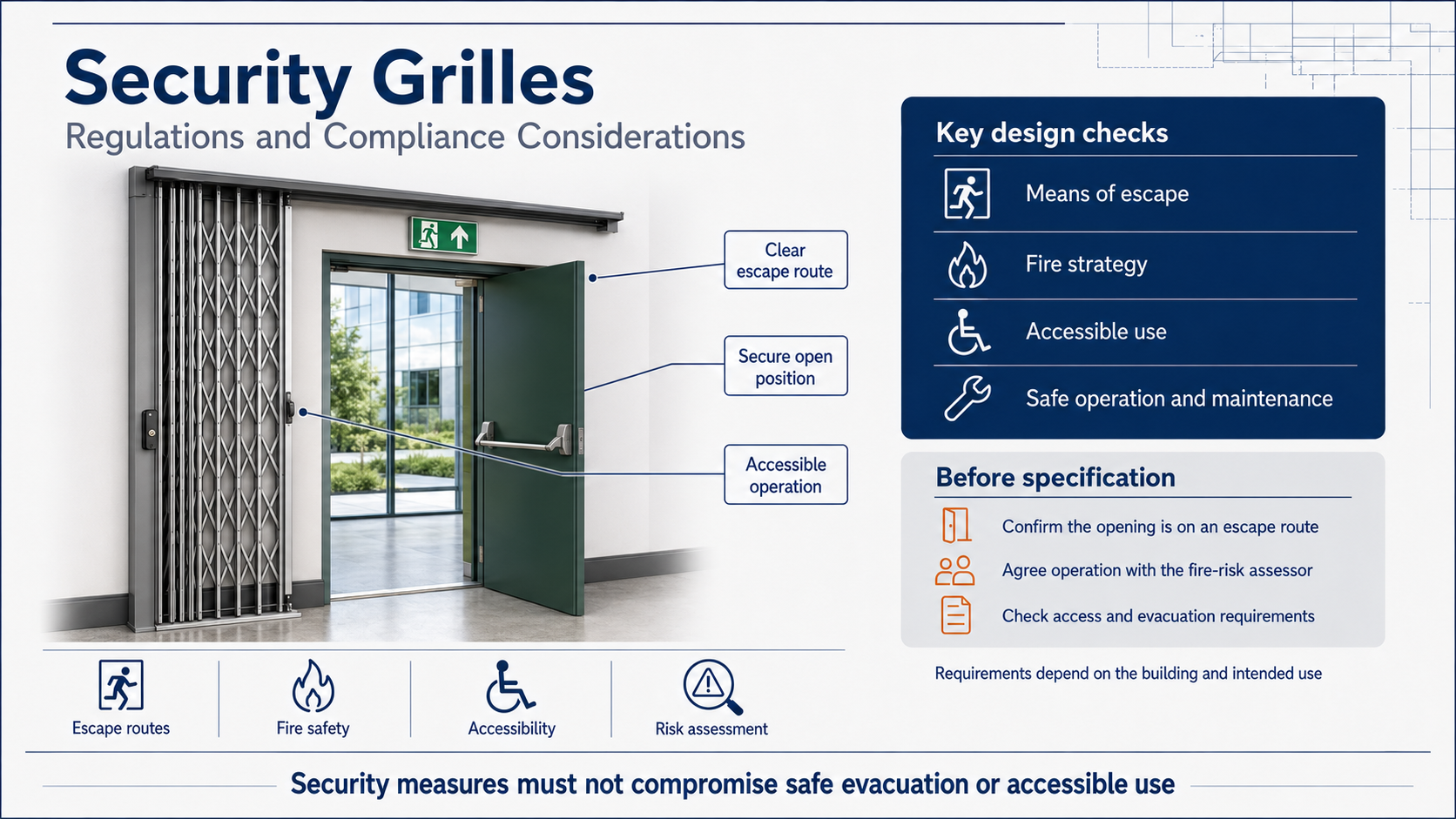
Security grilles are widely used in:
- Retail premises
- Schools
- Offices
- Reception areas
- Internal counters
- Shopfronts
While they provide effective physical security, they must also comply with UK regulations relating to:
- Means of escape (fire safety)
- Accessibility
- Building Regulations
- Workplace safety law
Incorrectly specified or installed grilles can create serious life safety and enforcement risks.
Means of Escape Requirements
The primary regulatory driver is:
- Building Regulations – Approved Document B (Fire Safety)
- The Regulatory Reform (Fire Safety) Order 2005
Escape routes must:
- Be available at all material times
- Open easily in the direction of escape (where required)
- Not require a key to exit
- Not be obstructed or locked shut
When Security Grilles Create Risk
A grille may create non-compliance if:
- It blocks a designated escape door
- It requires a key to open from the escape side
- It cannot be opened quickly in an emergency
- It reduces escape width below required minimum
- It is locked during occupied hours
If a grille covers a final exit door, it must not prevent safe and immediate escape.
Best Practice for Escape Doors
Where a grille protects an escape door:
- It should be open and secured in the open position during trading hours
- It must not require a key to open from the inside when occupied
- It must be integrated into the fire risk assessment
- Emergency release mechanisms may be required
- Fire officers routinely inspect this during audits.
Accessibility Requirements (Approved Document M)
Accessibility is governed by:
- Approved Document M (Access to and Use of Buildings)
- Equality Act 2010
Security grilles must not:
- Prevent accessible entry
- Restrict wheelchair access
- Create trip hazards
- Obstruct compliant door clear widths
Key Accessibility Considerations
Clear Opening Width
Escape and entrance doors must maintain required minimum clear widths.
A grille must not reduce usable width.
Thresholds & Floor Tracks
Tracked grilles must:
- Avoid raised thresholds
- Not create barriers for wheelchair users
- Not create trip hazards
Low profile or recessed tracks are often required.
Operating Force
Manual grilles must not require excessive force to operate, particularly where part of an accessible entrance.
Shopfront & Retail Grilles
- Grilles must not obstruct emergency escape routes
- Mall grilles in shopping centres must comply with centre management fire strategy
- Locked-down grilles must be open during occupied hours
In some shopping centres, grilles must integrate with fire alarm systems.
Fire Strategy Considerations
Security grilles are not fire-rated unless specifically tested.
They must not:
- Interfere with fire shutters
- Obstruct smoke ventilation
- Block automatic fire doors
- Compromise compartmentation
Always check interaction with the building’s fire strategy.
External Security Grilles & Final Exits
For security grilles protecting final exits:
- Internal emergency release may be required
- They must not trap occupants
- They must integrate with panic hardware where applicable
If the door behind is fitted with BS EN 1125 panic hardware, the grille must not negate that function.
Planning & Aesthetic Considerations
In some locations (particularly town centres or conservation areas):
- Planning permission may affect external grilles
- Solid grilles may be restricted
- Open lattice grilles are often preferred
Local authority requirements should be checked.
Common Compliance Failures
We frequently see:
- Grilles padlocked across fire exits
- Final exits reduced in width
- No internal emergency override
- Heavy manual grilles installed on accessible entrances
- Floor tracks creating trip hazards
- Escape doors obstructed after refurbishment
These can result in enforcement notices.
When Should You Review Your Security Grilles?
- During shop refurbishments
- When changing building use
- After a fire risk assessment
- Before a fire authority inspection
- When upgrading shopfront security
Need Advice on Compliant Security Grilles?
If you are installing or upgrading:
- Shopfront roller grilles
- Internal security grilles
- Counter shutters
- School security grilles
We can advise on:
- Escape compliance
- Accessibility requirements
- Fire strategy integration
- Insurance considerations
Contact us to discuss your project.
Frequently Asked Questions
Can a security grille be installed over a fire exit?
Can a security grille be installed over a fire exit?
Yes — but it must not prevent safe and immediate escape.
If a grille protects a designated fire exit:
- It must not be locked shut while the building is occupied
- It must not require a key to escape
- It must not reduce the required escape width
- It must open easily from the inside
The fire risk assessment should confirm the arrangement is compliant.
Do security grilles need to comply with Building Regulations?
Do security grilles need to comply with Building Regulations?
Yes.
Security grilles must comply with relevant parts of the Building Regulations, including:
- Approved Document B (Fire Safety – means of escape)
- Approved Document M (Access and Use of Buildings – accessibility)
They must not compromise escape routes or accessible entrances.
Can I padlock a security grille during business hours?
Can I padlock a security grille during business hours?
No, not if it affects an escape route.
Padlocking a grille across a final exit while the premises are occupied is a common cause of enforcement action. Escape doors must be openable without a key at all times when the building is in use.
Do floor tracks on grilles create accessibility issues?
Do floor tracks on grilles create accessibility issues?
They can.
Floor tracks must:
- Not create trip hazards
- Not obstruct wheelchair users
- Maintain compliant threshold levels
In accessible entrances, recessed or low-profile tracks are often required to remain compliant with Approved Document M and the Equality Act.
Are security grilles fire-rated?
Are security grilles fire-rated?
No, security grilles are not fire rated.
They are designed for physical security, not fire resistance. If fire separation is required, a certified fire shutter or fire curtain system may be necessary.
Security products must not interfere with fire doors, fire shutters or smoke control systems.


