

Building Regulations Part O & Part K
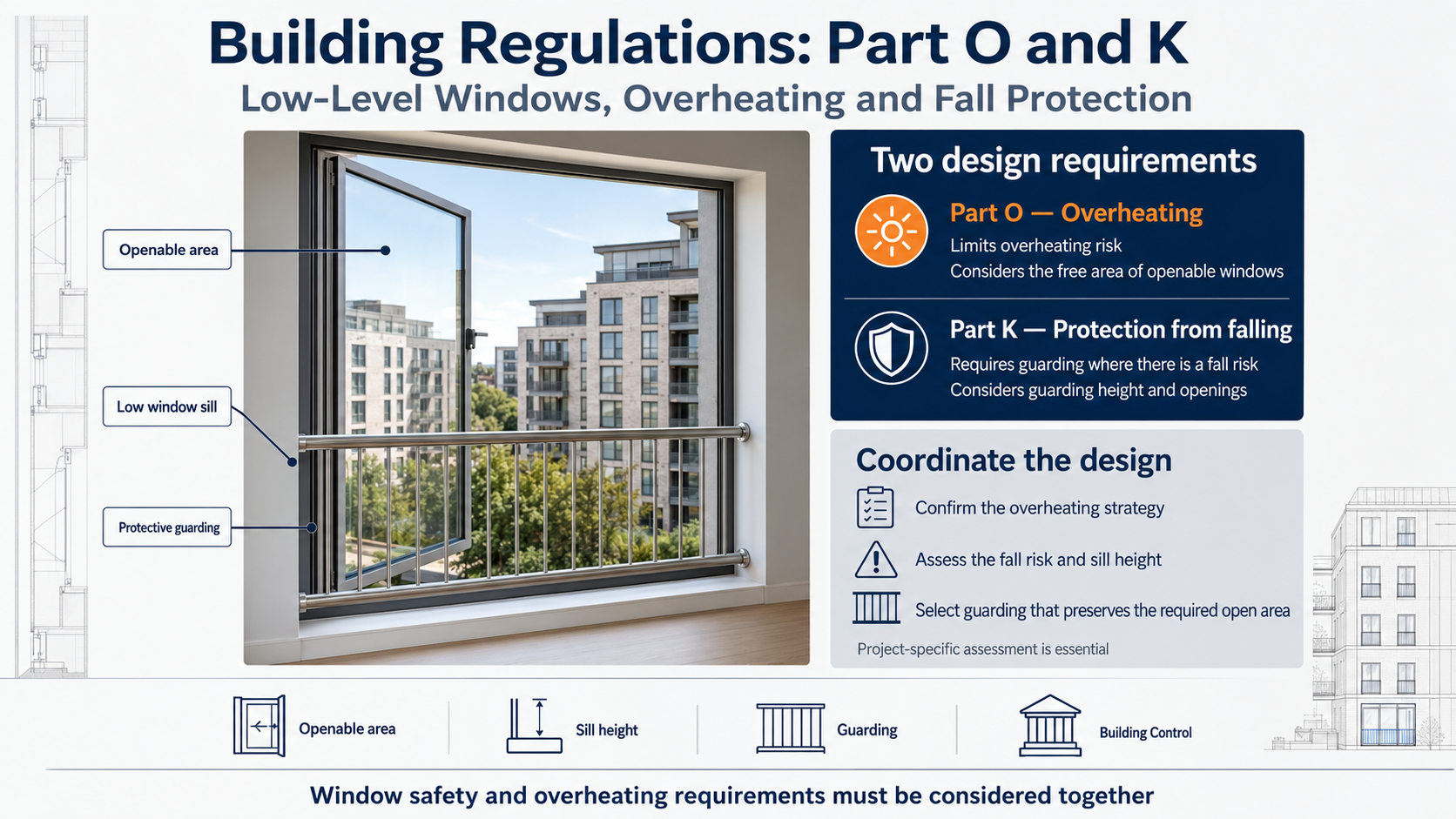
In modern residential buildings, window design must now balance two critical regulatory requirements:
- Part O – Overheating (Approved Document O)
- Part K – Protection from Falling (Approved Document K)
Where larger or lower-level opening windows are introduced to meet ventilation requirements under Part O, fall protection requirements under Part K often apply.
This is where low window safety bars and guarding barriers become essential.
Part O – Overheating (Ventilation Strategy)
Approved Document O was introduced to reduce overheating risk in new residential buildings in England.
To comply, designers often need to:
- Increase natural ventilation
- Provide purge ventilation openings
- Allow greater window opening areas
- Enable night-time cooling
This frequently results in:
- Larger openable sections
- Lower sill heights
- Windows opening wider than traditional restricted openings
While this improves thermal performance, it can introduce fall risks.
Part K – Protection from Falling
Approved Document K addresses fall prevention in buildings.
Under Part K:
- Where there is a risk of falling more than 600mm, guarding may be required
- Guarding is typically required where window openings are low
- Openings in guarding must prevent a 100mm sphere from passing through
- Guarding must be structurally adequate
In residential buildings, guarding is commonly required where:
- Window sills are below approximately 800mm from finished floor level
- The window is above ground level
- The opening size creates a fall hazard
Exact requirements depend on building type and design.
How Part O and Part K Work Together
In many modern apartment developments:
- Part O requires larger or more accessible window openings for overheating mitigation.
- Larger openings increase fall risk.
- Part K requires guarding to prevent falls.
Window restrictors alone may not always satisfy both:
- Part O ventilation requirements
- Part K fall protection requirements
In these cases, a fixed internal guarding solution is often the compliant approach.
When Are Low Window Safety Bars Required?
Low window safety bars or guarding barriers are commonly required where:
- Full height glazing is used
- Sill heights are low
- Juliette-style internal windows are installed
- Student accommodation includes large openable windows
- Care or supported housing requires enhanced safeguarding
They are especially common in:
- High rise residential blocks
- Urban apartment schemes
- Residential refurbishments upgrading glazing
- Build to rent developments
Why Restrictors May Not Be Enough
Window restrictors:
- Can be overridden
- May not meet ventilation opening size requirements
- Do not provide full guarding
- May not satisfy safeguarding expectations
Where a window must open wide to meet Part O purge ventilation requirements, a permanent guarding barrier provides a safer and more robust solution.
Low Window Safety Bars & Barriers
Our low window safety bars and internal guarding barriers are designed to:
- Provide compliant fall protection under Part K
- Allow required ventilation under Part O
- Prevent passage through openings
- Maintain structural integrity
- Integrate discreetly within residential interiors
They are suitable for:
- Apartment developments
- Student accommodation
- Care environments
- Residential refurbishments
- Window replacement projects
Key Compliance Considerations
When specifying window guarding:
- Guarding height must be appropriate for the application
- Openings must not allow a 100mm sphere to pass
- Fixings must be structurally sound
- The barrier must resist imposed loads
- Installation substrate must be suitable
Guarding must not introduce climbable features.
Common Compliance Failures
We frequently see:
- Full opening low-level windows installed without guarding
- Reliance solely on restrictors where larger openings are required
- Guarding fixed into non-structural substrates
- No coordination between architect and window supplier
- Safety bars installed after completion as reactive measures
These issues can result in Building Control queries or liability exposure.
Design Stage Advice
To avoid compliance issues:
- Coordinate Part O ventilation strategy with Part K guarding early
- Review sill heights at design stage
- Confirm purge ventilation sizes
- Specify guarding where needed before window procurement
- Include fall protection in Building Control submissions
Retrofitting later is always more costly.
Need Advice on Part O & Part K Compliance?
If you are:
- Designing new residential schemes
- Upgrading glazing in existing apartments
- Managing student accommodation
- Responding to Building Control queries
We can advise on compliant low window safety bars and internal guarding solutions that balance ventilation and fall protection.
Contact us to discuss your project.
Frequently Asked Questions
When do I need guarding to a low window under Building Regulations?
When do I need guarding to a low window under Building Regulations?
Guarding is generally required under Approved Document K where:
- The internal floor level is more than 600mm above the external ground level, and
- The window opening presents a fall risk, typically where the sill height is below approximately 800mm.
If the window can open wide and is located above ground level, fall protection measures may be required.
How does Part O affect low window design?
How does Part O affect low window design?
Approved Document O may require larger opening areas to achieve purge ventilation and reduce overheating risk.
Where windows must open wider to comply with Part O, traditional restrictors may not be sufficient. In these cases, fixed guarding or low window safety barriers are often required to satisfy Part K fall protection requirements.
Are window restrictors enough to comply with Part K?
Are window restrictors enough to comply with Part K?
Not always.
Restrictors can limit opening size, but they may:
- Be overridden or disengaged
- Not meet ventilation requirements under Part O
- Fail to provide adequate guarding in higher-risk situations
Where full opening is required, permanent guarding may be the more compliant solution.
What are the typical guarding requirements for low windows?
What are the typical guarding requirements for low windows?
Under Part K, guarding must:
- Prevent a 100mm sphere from passing through
- Be structurally secure and properly fixed
- Be suitable for the height and risk level of the building
- Resist reasonable imposed loads
The guarding should not create climbable hazards.
Does this apply to refurbishment and window replacement projects?
Does this apply to refurbishment and window replacement projects?
Yes.
Where windows are replaced and:
- Opening sizes increase
- Sill heights are reduced
- Ventilation strategy changes
Building Control may require compliance with current regulations, including Parts O and K.
Low window safety bars can provide a compliant retrofit solution in these situations.


