

BS EN 1125 & BS EN 179 - Panic and Emergency Exit Hardware Explained
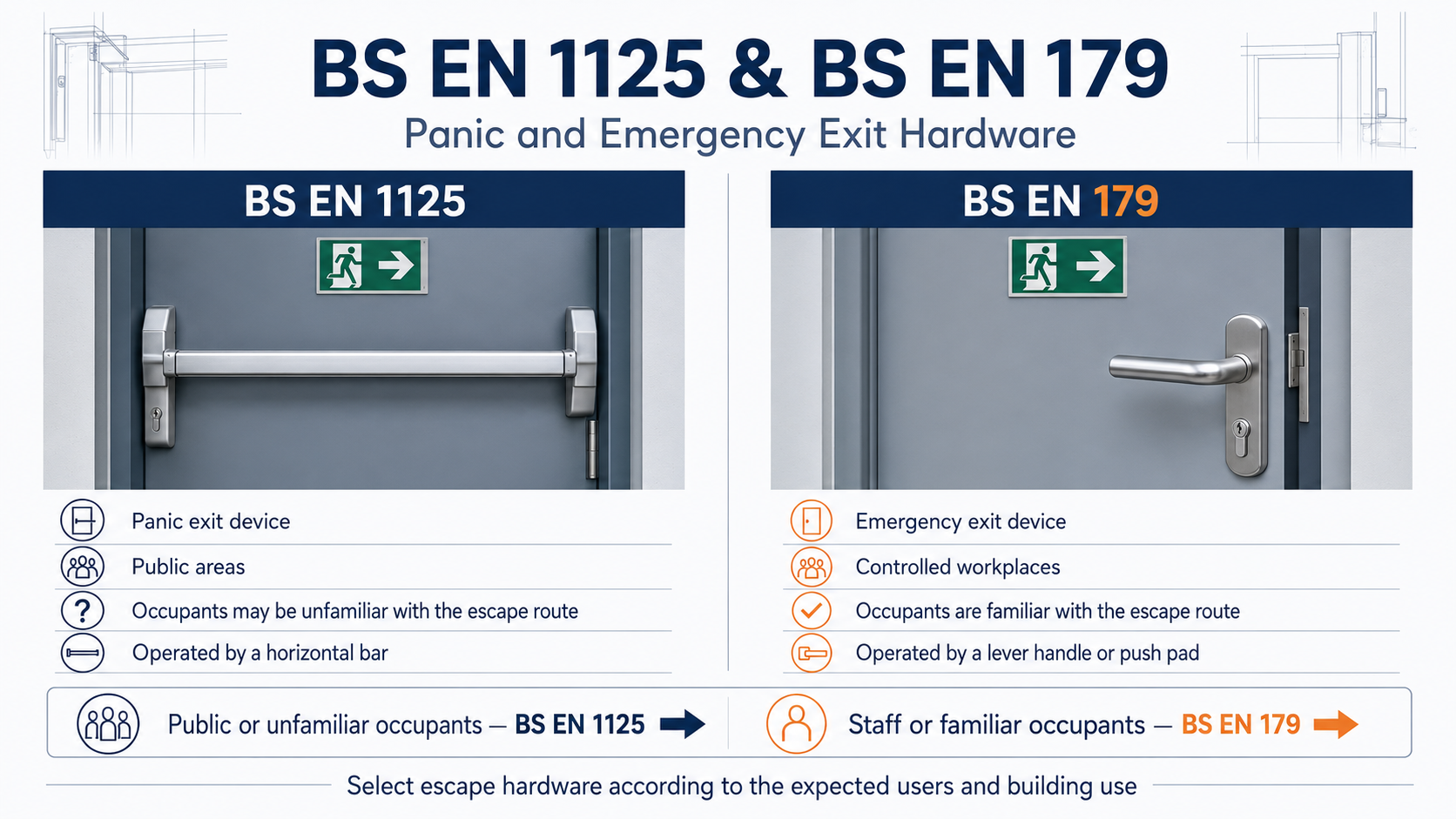
When a building must be evacuated quickly, the type of door hardware fitted can be the difference between safe escape and serious risk.
BS EN 1125 and BS EN 179 are the key European standards governing panic and emergency exit hardware on escape route doors.
They define when panic bars, push pads, or lever-operated emergency devices must be used, and in what type of building.
If you install or maintain fire doors or escape doors, these standards are critical.
What Is BS EN 1125?
BS EN 1125 applies to panic exit devices operated by a horizontal bar.
These are commonly known as:
- Panic bars
- Crash bars
- Touch bars
It is required where:
- The building is open to the public
- Occupants may be unfamiliar with escape routes
- A panic situation could reasonably occur
- Schools
- Retail premises
- Shopping centres
- Cinemas
- Hospitals
- Public offices
- Entertainment venues
In these environments, users must be able to push anywhere on the bar to escape without needing prior knowledge of door operation.
What Is BS EN 179?
BS EN 179 applies to emergency exit devices operated by a lever handle or push pad.
These devices require more deliberate operation than a panic bar.
Where:
- Occupants are familiar with the building
- Staff are trained
- There is no expectation of public panic
- Offices
- Warehouses
- Industrial buildings
- Staff-only areas
- Plant rooms
The Key Difference
BS EN 1125
- Horizontal Panic Bar
- Public / unfamiliar occupants
- Retail, schools, hospitals
BS EN 179
- Lever Handle or Push Pad
- Trained/Familiar Occupants
- Offices, warehouses
In simple terms:
If the public use the building → BS EN 1125
If only trained staff use the building → BS EN 179
Relationship to Approved Document B
Approved Document B requires doors on escape routes to:
- Open in the direction of escape (where occupancy thresholds are met)
- Be easily and immediately openable
- Not require a key for escape
BS EN 1125 and BS EN 179 provide the compliant hardware solutions to meet those requirements.
Building Control and fire officers expect correct hardware classification.
Fire Doors and Panic Hardware
Where the escape door is also a fire door:
- The panic hardware must be compatible with the tested fire door assembly
- Hardware must not invalidate the fire rating
- Substituting non approved hardware can compromise compliance
Fire doors serving escape routes often require:
- EI30 or EI60 rating
- Sa smoke classification
- CE/UKCA marked panic hardware
CE / UKCA Marking
Panic and emergency exit devices must:
- Be tested to the relevant standard
- Be correctly classified
- Carry CE or UKCA marking (subject to current UK regulations)
- Be supported by Declaration of Performance documentation
Using non-certified hardware exposes building owners to enforcement risk.
Installation Considerations
Correct installation is critical.
Common issues include:
- Incorrect door thickness compatibility
- Poor alignment causing latch failure
- Incorrect fixing to steel or composite doors
- Missing intumescent protection where required
- Hardware not matching fire test evidence
Installation should follow manufacturer instructions and tested configurations.
Maintenance Responsibilities
Under fire safety legislation:
- Escape hardware must be maintained in efficient working order
- Devices must release easily without excessive force
- Mechanisms must not bind or stick
- Regular inspection should form part of fire door checks
In residential blocks, this may form part of communal fire door inspections.
Common Compliance Mistakes
We frequently see:
- Lever handles fitted where panic bars are required
- Public buildings incorrectly fitted with BS EN 179 hardware
- Non-certified hardware installed on fire doors
- Panic bars removed due to misuse
- Doors locked with additional bolts
All can create serious legal and life safety risks.
When Should You Review Your Hardware?
You should assess compliance if:
- Refurbishing a commercial building
- Changing building use
- Upgrading fire doors
- Preparing for Building Control inspection
- Responding to fire risk assessment findings
Correct hardware selection should be based on occupancy type, not cost.
Need Advice on Compliant Escape Doors?
If you are installing or upgrading:
- Steel emergency fire exit doors
- Fire rated escape doors
- Commercial doorsets
- Warehouse exits
We can advise on:
- Correct hardware specification
- Compatibility with fire ratings
- Compliance with Building Regulations
- Maintenance and inspection support
Contact us to discuss your project.
Frequently Asked Questions
How do I know whether I need BS EN 1125 or BS EN 179 hardware?
How do I know whether I need BS EN 1125 or BS EN 179 hardware?
It depends on who uses the building.
- BS EN 1125 (panic bar) is required where the public may use the building and may be unfamiliar with escape routes.
- BS EN 179 (lever or push pad) is suitable where occupants are trained and familiar with the building layout.
If the building is open to the public, BS EN 1125 is generally expected.
Can I use a lever handle instead of a panic bar in a public building?
Can I use a lever handle instead of a panic bar in a public building?
No, not if the door serves an escape route in a public-access building.
In locations such as schools, retail units, healthcare buildings or entertainment venues, panic bars compliant with BS EN 1125 are normally required to ensure immediate operation under panic conditions.
Using the wrong hardware can result in Building Control or fire authority enforcement action.
Does panic hardware need to be fire-rated?
Does panic hardware need to be fire-rated?
Yes if it is fitted to a fire door.
Escape hardware must be compatible with the tested fire door assembly and covered within the door’s fire test evidence or Field of Application. Installing non-approved hardware can invalidate the door’s fire resistance rating.
Do panic bars and emergency exit devices require certification?
Do panic bars and emergency exit devices require certification?
Yes.
Devices must be:
- Tested to BS EN 1125 or BS EN 179
- CE or UKCA marked (subject to current regulations)
- Supplied with supporting documentation such as a Declaration of Performance
Certification ensures the device meets durability and safety performance requirements.
How often should panic hardware be inspected?
How often should panic hardware be inspected?
Escape hardware should be checked regularly as part of routine fire door inspections.
Inspections should confirm:
- The device operates smoothly
- The latch releases easily
- The door opens fully in the direction of escape
- No additional locks or obstructions are fitted
Any defects should be addressed immediately, as escape hardware is a life safety component.


