

BS EN 1634-1 – Fire Resistance Testing for Doors, Shutters and Openable Windows
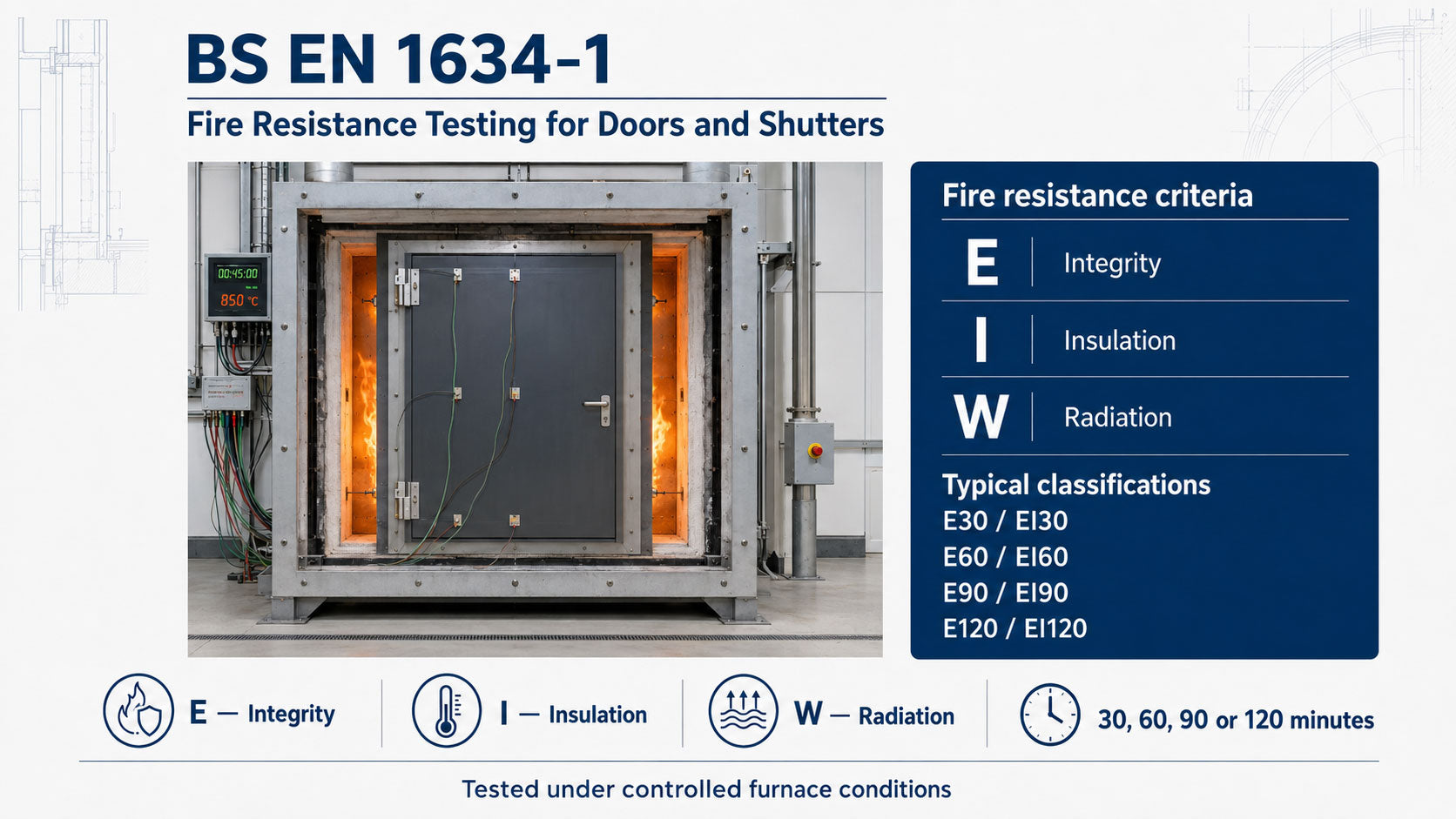
BS EN 1634-1 is the UK-aligned European standard that defines how fire doors, shutters and similar assemblies must be tested to measure their fire-resisting performance under controlled fire conditions. It is one of the most important test methods used to demonstrate that a door or shutter can safely resist fire for a specified period, such as 30, 60, 90 or 120 minutes, in its intended application.
Why BS EN 1634-1 Matters
Fire doors and shutters are critical components of a building’s passive fire protection system. Their performance has a direct impact on:
- Containing fire and smoke spread between compartments
- Protecting escape routes during evacuation
- Providing safe evacuation time for building occupants
- Protecting property and reducing damage in a fire event
Without reliable test evidence from BS EN 1634-1 or an equivalent standard, there is no objective measure that a doorset will perform as intended in a real fire.
What BS EN 1634-1 Actually Tests
BS EN 1634-1 specifies a full-scale fire test carried out in a furnace under controlled conditions. The test assesses how long the complete assembly will resist fire exposure based on key criteria:
Can the assembly prevent flames or hot gases from passing through and igniting materials on the unexposed side?
Does the assembly limit the heat transfer to the non-fire side — helping stop nearby materials from overheating?
Does it reduce radiant heat on the unexposed side, further protecting adjacent elements?
These criteria are used to generate time-based fire resistance ratings such as:
- E30 / EI30 – 30 minutes of fire resistance
- E60 / EI60 – 60 minutes
- E90 / EI90 – 90 minutes
- E120 / EI120 – 120 minutes
The exact rating required depends on the building’s fire strategy and regulatory context.
How the Testing Works
A full doorset is built and conditioned, then installed in a standardised test furnace. Temperature and pressure conditions simulate real fire growth. Thermocouples and instruments monitor performance throughout the test. The assembly is observed for:
- Structural failure
- Flame or gas leakage
- Exposed surface temperature rise
If it meets the criteria for the required duration without failure, it is then classified accordingly.
What Products Are Covered
BS EN 1634-1 applies to:
- Fire doors - steel, composite and glazed doors
- Fire shutters - rolling or sliding fire shutters
- Openable windows and similar closures that contribute to compartmentation
- Associated hardware when included as part of the tested assembly (including the frame and seals)
Important: The test applies to the entire assembly. Changing any component (e.g., lockset, hinge, frame type) that is not covered by the tested configuration can invalidate the rating unless there is a Field of Application (FoA) showing it is within scope.
BS EN 1634-1 vs Other Fire Test Standards
In the UK, fire doors have traditionally been tested to BS 476-22. However:
- BS EN 1634-1 is now the modern benchmark for fire resistance testing and necessary for CE/UKCA marking of doorsets.
- EN 1634-1 is generally more rigorous, with stricter temperature and assessment criteria.
- EN 1634-1 results are commonly used as the basis for harmonised classification under BS EN 13501-2.
Most regulatory and specification documents now expect evidence from EN 1634-1 rather than the older BS 476-22 test.
How BS EN 1634-1 Supports Compliance
Although BS EN 1634-1 itself is a test method rather than a regulation, it underpins:
- Building Regulations compliance (via Approved Document B guidance in England)
- Fire safety strategies in risk assessments
- Third-party certification schemes and product labelling
- Traceable evidence for safety files, handovers and audits
Products tested and certified under BS EN 1634-1 also form part of the evidence builders, designers, fire engineers, and duty holders rely on to demonstrate performance under the Regulatory Reform (Fire Safety) Order and building control requirements.
Next Steps for Your Project
If you need help with:
- Specifying doorsets or shutters to meet required fire resistance ratings
- Interpreting test evidence and Field of Application documentation
- Preparing compliance packs for building control or safety files
Contact us to discuss your building type and fire safety requirements. We can review performance documentation and advise on compliant solutions tailored to your project.
Frequently Asked Questions
What does BS EN 1634-1 test?
What does BS EN 1634-1 test?
BS EN 1634-1 tests the fire resistance performance of a complete door, shutter or openable window assembly under controlled furnace conditions.
It measures how long the full assembly (leaf, frame, seals, ironmongery, glazing where applicable) can resist fire exposure in terms of:
- Integrity (E) – preventing flames and hot gases passing through
- Insulation (I) – limiting heat transfer to the non-fire side
- Radiation (W) – reducing radiant heat (where applicable)
The result is expressed as a time classification, such as EI30 or EI60.
Is BS EN 1634-1 the same as BS 476-22?
Is BS EN 1634-1 the same as BS 476-22?
No.
BS 476-22 is the older UK fire resistance test method.BS EN 1634-1 is the European-aligned standard now widely used across the UK and required for CE/UKCA marking of doorsets under related product standards.
Most modern specifications and building control approvals prefer or require BS EN 1634-1 evidence.
Does a door leaf tested to BS EN 1634-1 automatically make any installation compliant?
Does a door leaf tested to BS EN 1634-1 automatically make any installation compliant?
No.
The test applies to the complete tested assembly — not just the door leaf. Changing components such as:
- Hinges
- Locks
- Closers
- Frames
- Intumescent seals
- Glazing systems
can invalidate the fire rating unless they are covered within the test evidence or a valid Field of Application (FoA).
Installation must match the tested configuration.
How do I know what rating I need (E30, EI60, etc.)?
How do I know what rating I need (E30, EI60, etc.)?
The required rating depends on:
- The building’s fire strategy
- Compartmentation requirements
- Location within the building (e.g., stair core, corridor, plant room)
- Building height and use
This is usually defined by the fire engineer or specified within Approved Document B (England) or equivalent guidance in Scotland and Northern Ireland.Always confirm the required performance before procurement.
Does BS EN 1634-1 include smoke control testing?
Does BS EN 1634-1 include smoke control testing?
No.
BS EN 1634-1 covers fire resistance testing only.
Smoke leakage testing is carried out under BS EN 1634-3.Where smoke control is required (for example, doors protecting escape routes), you should ensure appropriate smoke performance classification is also provided.
View Our BS 1634-1 Range


Choose your option


Choose your option


Choose your option


