

BS 8524:2025 and Active Fire Curtains
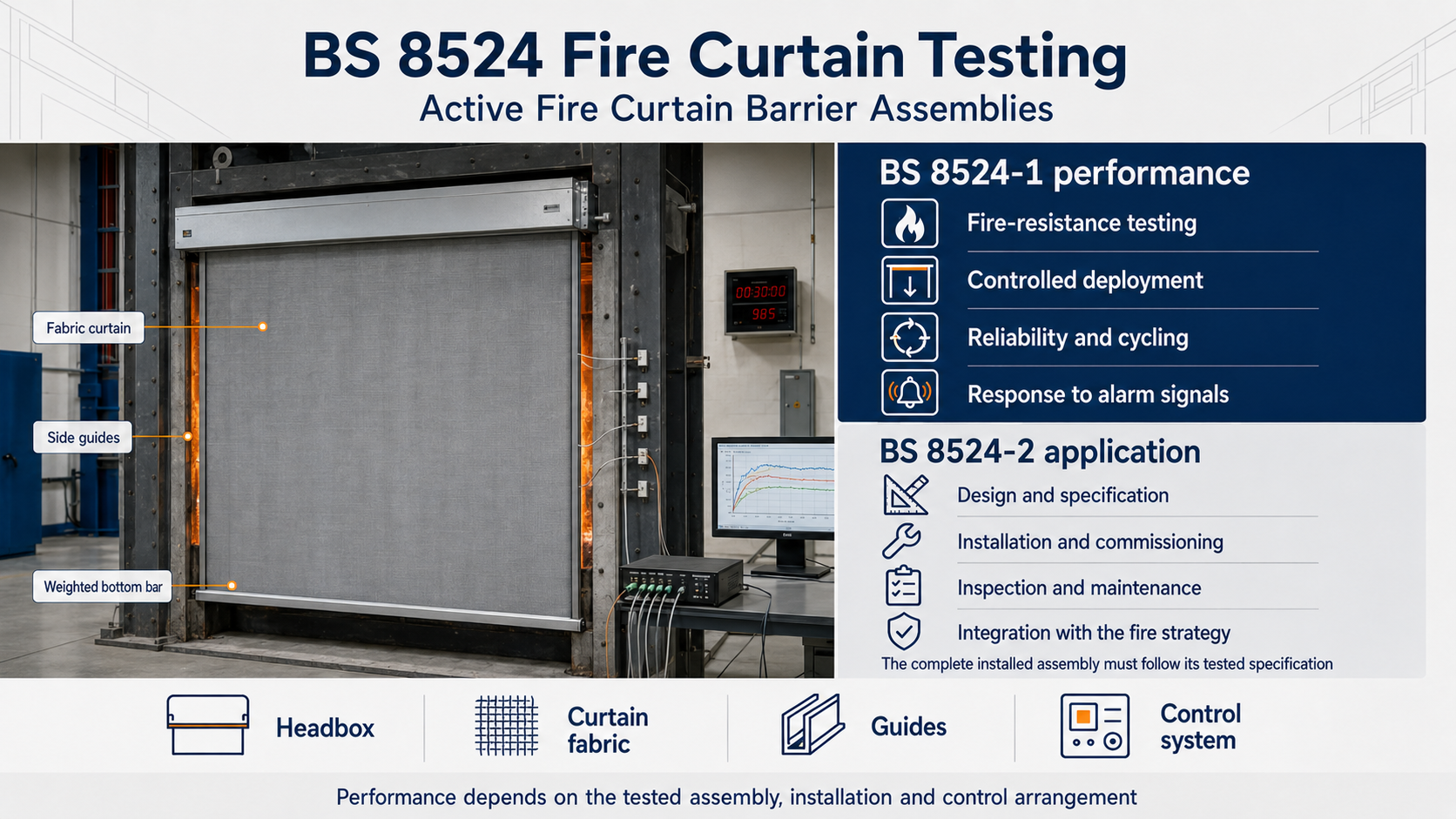
BS 8524 is the British Standard specifically developed for active fire curtain barrier assemblies.
It covers the performance of the complete fire curtain system, together with its application, installation, commissioning and ongoing maintenance.
BS 8524 is divided into two parts:
- BS 8524-1 – Specification: Covers the design, testing and performance of the fire curtain assembly.
- BS 8524-2 – Code of practice: Covers how fire curtains should be selected, installed, commissioned, handed over and maintained.
Both parts are important. Suitable product evidence alone does not guarantee that a fire curtain will perform correctly. It must also be properly specified, installed, commissioned, tested and maintained.
Important Update: BS 8524:2025
BS 8524-1:2025 and BS 8524-2:2025 were published on 21 November 2025. The previous 2013 editions were withdrawn on the same date.
Many active fire curtains currently installed or available within the UK were tested against BS 8524-1:2013 before the revised standard was introduced.
Evidence against BS 8524-1:2013 does not, by itself, demonstrate that a product meets BS 8524-1:2025. A product supported only by evidence against the 2013 edition must not be described as tested, certified or compliant with the 2025 edition.
Withdrawal of the 2013 edition does not automatically mean that an existing fire curtain is unsafe, unlawful or unsuitable. However, its suitability must be assessed against the requirements of the individual project.
Is Testing or Certification to BS 8524-1:2025 Available?
As at August 2026, Security Direct has not been provided with evidence that any active fire curtain manufacturer has completed testing against, or holds accredited third-party product certification to, BS 8524-1:2025.
This position may change as manufacturers, testing laboratories and certification bodies complete their work under the revised standard.
Any supplier claiming that a fire curtain meets BS 8524-1:2025 should be asked to provide current documentary evidence identifying:
- the applicable standard and edition;
- the product and configurations covered;
- the test and classification reports;
- the certification body, where certification is claimed;
- the scope of the certificate; and
- the accreditation applicable to the claimed testing or certification.
A fire test report, a manufacturer’s declaration and independent third-party product certification are different forms of evidence and should not be treated as interchangeable.
Security Direct’s Current Position
Security Direct is no longer offering the FC8 fire curtain or other active fire curtains supported only by evidence against BS 8524-1:2013 for new projects.
We have taken this decision because fire curtains are life safety products and we do not believe products supported only by evidence against the withdrawn edition should be offered as meeting the current 2025 standard.
We will review this position when suitable products and supporting evidence against BS 8524-1:2025 become available.
What Should I Do If a BS 8524 Fire Curtain Has Been Specified?
If a BS 8524 fire curtain is included within your specification, fire strategy or Building Control approval, we recommend that you:
- Make your architect, fire engineer and Building Control aware of the change to BS 8524.
- Confirm whether the specification expressly requires BS 8524-1:2025.
- Establish what test, classification and certification evidence is required.
- Ask the proposed supplier to provide the complete supporting evidence.
- Obtain written approval for the proposed solution before placing an order.
Security Direct cannot determine whether evidence against BS 8524-1:2013 is acceptable for a particular building. That decision must be made by the suitably qualified professionals responsible for the project and its fire strategy.
Alternative Fire Curtains Tested to BS EN 1634
Depending on the project requirements, an operable fabric fire curtain tested to other recognised fire-test standards may provide an alternative.
This may include a fire curtain with appropriate evidence to:
- BS EN 1634-1 for fire-resistance performance; and
- BS EN 1634-3 where tested smoke-control performance is required.
BS EN 1634-1 expressly includes operable fabric curtains within its scope. However, testing to BS EN 1634-1 does not demonstrate compliance with BS 8524-1:2025.
BS 8524 addresses additional aspects of an active fire curtain system, including operational reliability, repeated deployment, controls, power failure, ancillary equipment and maintenance. The standards must not therefore be treated as directly interchangeable.
Before accepting a BS EN 1634-tested fire curtain, its supporting evidence should be checked to confirm that it covers:
- the required fire and smoke classifications;
- the proposed opening width and drop;
- the curtain assembly and operating configuration;
- the supporting construction and fixings;
- the motor, controls and power arrangements;
- the fire-alarm interface; and
- any permitted field-of-application limitations.
Where BS 8524 has already been specified, the proposed BS EN 1634-tested alternative must be referred to the project’s architect, fire engineer and Building Control. Written approval should be obtained before an order is placed.
Can a Product Tested to BS 8524-1:2013 Still Be Used?
Withdrawal of a British Standard does not automatically make a previously tested product illegal, unsafe or unsuitable.
However, acceptance of a product supported by evidence against a withdrawn standard will depend on the particular project, including:
- the wording of the specification;
- the approved fire strategy;
- the required fire-resistance classification;
- the date and contractual basis of the design;
- the proposed supporting construction;
- the opinion of the project’s fire engineer;
- Building Control requirements; and
- the quality and scope of the available test and assessment evidence.
Where a project expressly requires BS 8524-1:2025, evidence against BS 8524-1:2013 should not be presented as meeting that requirement.
Any proposed use of evidence against the 2013 edition should be disclosed clearly and accepted by the relevant designer, fire engineer or Building Control body before an order is placed.
Is BS 8524 a Legal Requirement?
BS 8524 is a British Standard rather than legislation.
However, compliance may be required by:
- the approved fire strategy;
- the project specification;
- Building Control;
- the architect or fire engineer;
- the client or principal designer;
- an insurer; or
- contractual requirements.
The correct standard and supporting evidence must therefore be established for each project.
Discuss an Alternative Fire Curtain
Security Direct can provide information about alternative operable fabric fire curtains tested to BS EN 1634-1 and, where required, BS EN 1634-3.
If a BS 8524 active fire curtain has been specified, please send us:
- the project specification;
- the relevant fire-strategy drawings;
- the required fire and smoke classifications;
- the opening dimensions;
- details of the supporting construction; and
- any product-certification requirements.
We can provide the available technical and test evidence for consideration by your architect, fire engineer and Building Control.
Frequently Asked Questions
What is an active fire curtain?
What is an active fire curtain?
An active fire curtain is a deployable fire-resistant barrier. It normally remains retracted within a headbox and descends automatically when activated by a fire alarm or control system.
It may form part of a building’s fire-compartmentation or escape strategy where a permanent wall or conventional fire door would be impractical.
What is the difference between BS 8524-1 and BS 8524-2?
What is the difference between BS 8524-1 and BS 8524-2?
BS 8524-1 is the product specification. It covers the design, testing and performance of the complete active fire curtain assembly.
BS 8524-2 is the code of practice covering its application, installation, commissioning, handover and ongoing maintenance.
Which editions of BS 8524 are current?
Which editions of BS 8524 are current?
BS 8524-1:2025 and BS 8524-2:2025 are the current editions. They were published on 21 November 2025 and replaced the corresponding 2013 editions.
Does testing to BS 8524-1:2013 demonstrate compliance with BS 8524-1:2025?
Does testing to BS 8524-1:2013 demonstrate compliance with BS 8524-1:2025?
No. Evidence against the 2013 edition does not, by itself, demonstrate conformity with BS 8524-1:2025.
A product supported only by evidence against the 2013 edition must not be described as tested, certified or compliant with the 2025 edition.
Does withdrawal of the 2013 edition make an existing fire curtain unsafe?
Does withdrawal of the 2013 edition make an existing fire curtain unsafe?
Not automatically. Withdrawal of a standard does not mean that a curtain tested or installed under the previous edition is necessarily unsafe.
Its continued suitability will depend on factors including its original specification, supporting evidence, installation, commissioning, maintenance and the requirements of the building’s fire strategy.
Is the FC8 compliant with BS 8524-1:2025?
Is the FC8 compliant with BS 8524-1:2025?
No. BLE has confirmed that the FC8 has not been tested, assessed or certified against BS 8524-1:2025.
Its supporting evidence relates to BS 8524-1:2013. It must not therefore be described or offered as compliant with the current 2025 edition.
Does the FC8 have independent third-party certification to BS 8524-1?
Does the FC8 have independent third-party certification to BS 8524-1?
No. BLE has confirmed that the FC8 does not hold independent third-party product certification to BS 8524-1.
Fire-test evidence and independent third-party product certification are different forms of evidence and must not be treated as interchangeable.
Does any manufacturer currently hold BS 8524-1:2025 certification?
Does any manufacturer currently hold BS 8524-1:2025 certification?
As at August 2026, Security Direct has not been provided with evidence that any active fire curtain manufacturer holds accredited third-party product certification to BS 8524-1:2025.
This position may change. Any supplier claiming certification should be asked to provide the current certificate, its scope, the products and configurations covered, and evidence of the certification body’s relevant accreditation.
Is Security Direct still selling the FC8?
Is Security Direct still selling the FC8?
No. Security Direct has discontinued the FC8 and is not accepting new orders for this product.
This page remains available to explain the standards transition and help customers and specifiers understand the available alternatives.
Can a fire curtain tested to BS EN 1634-1 be considered instead?
Can a fire curtain tested to BS EN 1634-1 be considered instead?
Depending on the project requirements, an operable fabric fire curtain supported by appropriate testing to BS EN 1634-1 may be considered as an alternative.
Where tested smoke-control performance is required, the product should also have appropriate supporting evidence to BS EN 1634-3.
Testing to these standards does not demonstrate compliance with BS 8524-1:2025, and the standards must not be treated as directly interchangeable.
What should I do if my specification requires a BS 8524 fire curtain?
What should I do if my specification requires a BS 8524 fire curtain?
Make your architect, fire engineer and Building Control aware of the change to BS 8524 and the evidence available for the proposed product.
If an alternative fire curtain tested to BS EN 1634-1 and, where required, BS EN 1634-3 is proposed, its complete supporting evidence should be reviewed by the responsible project professionals.
Written approval should be obtained before an order is placed.
What evidence should be checked for an alternative fire curtain?
What evidence should be checked for an alternative fire curtain?
The evidence should confirm that the proposed product and configuration cover:
- the required fire-resistance and smoke classifications;
- the proposed opening width and drop;
- the curtain assembly and operating arrangement;
- the supporting construction and fixings;
- the motor, controls and power arrangements;
- the fire-alarm interface; and
- any field-of-application limitations.
A general statement that a product is “fire rated” is not sufficient.
Can Security Direct provide an alternative?
Can Security Direct provide an alternative?
Security Direct can provide information about alternative operable fabric fire curtains tested to BS EN 1634-1 and, where required, BS EN 1634-3.
The suitability of any alternative must be assessed and approved by the project’s architect, fire engineer and Building Control against the approved fire strategy.


