

UK Roller Shutter Regulations & Safety Compliance Guide
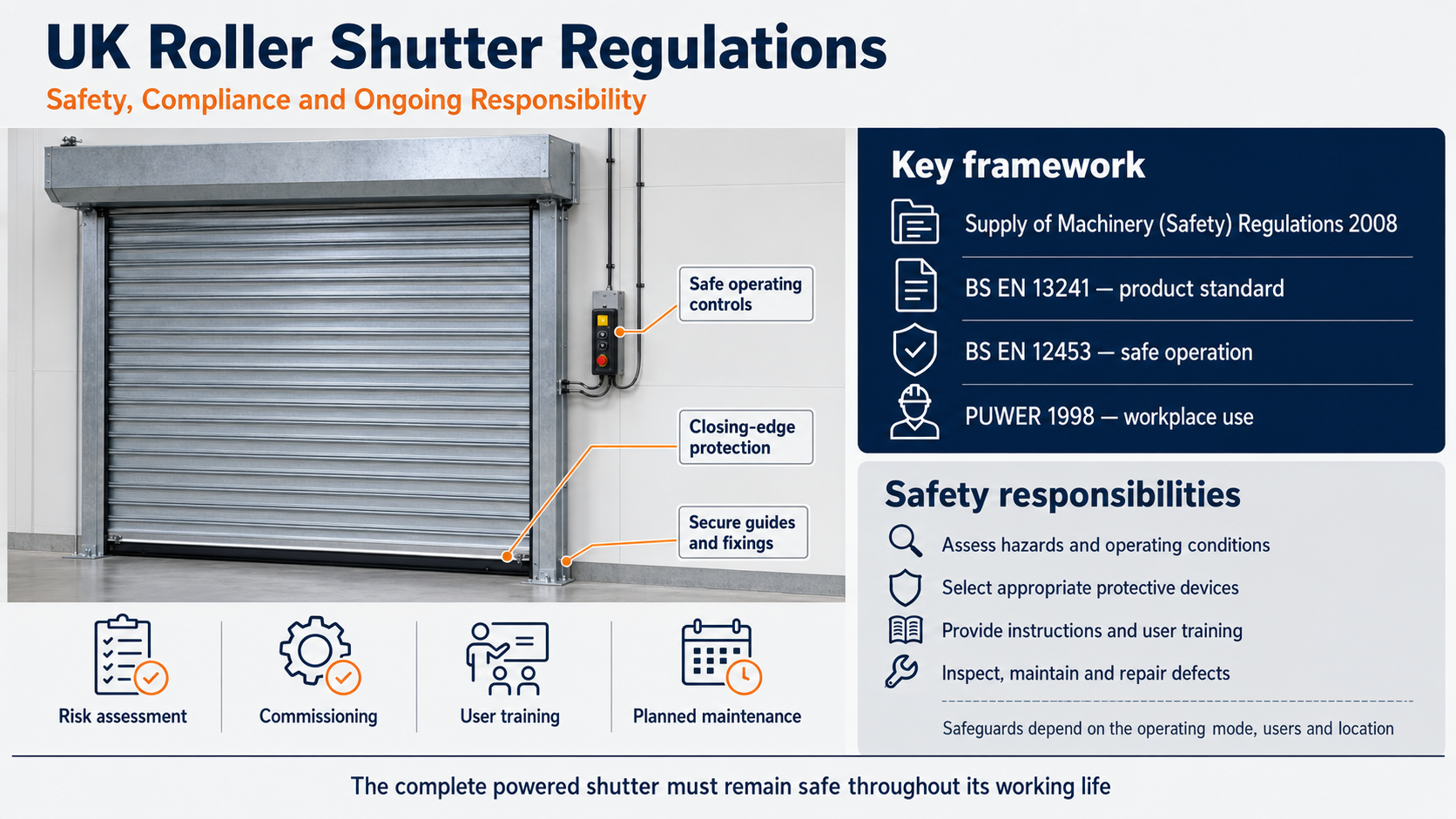
Roller shutters and industrial doors in the UK are subject to strict safety, legal, and compliance requirements. Whether you are a business owner, facilities manager, or property owner, it is essential to ensure your doors are compliant, not only to meet legal obligations but to protect users from serious injury.
This guide outlines the key UK regulations, standards, and responsibilities relating to roller shutters and industrial doors.
Why Compliance Matters
Roller shutters are classified as power-operated machinery. This means they fall under machinery safety legislation and must be:
- Designed and installed safely
- Maintained regularly
- Operated without risk to users
Failure to comply can result in:
- Injury or fatality
- Invalid insurance
- HSE enforcement action or prosecution
Key UK Regulations & Standards
This is the primary legislation covering powered roller shutters and industrial doors.
Applies to:
- Electric roller shutters
- Industrial doors
- Automated security grilles
Key requirements:
- Doors must be UKCA marked (or CE where applicable)
- A Declaration of Conformity must be provided
- A risk assessment must be carried out
- Safety devices must be installed to eliminate crushing, shearing, and impact risks
This is the main product standard for roller shutters and industrial doors.
Covers:
- Mechanical safety
- Operational safety
- Wind resistance
- Safe opening and closing forces
A compliant door must:
- Be tested to this standard
- Be installed in accordance with manufacturer guidelines
- Operate within safe force limits
Applies to all workplaces using roller shutters or industrial doors.
Key requirement:
Equipment must be maintained in an efficient state, in efficient working order, and in good repair.
This creates a legal obligation for regular servicing and maintenance.
This is one of the most important regulations for business owners.
Applies to:
- Any powered door used by employees or the public
Key responsibilities:
- Ensure equipment is safe to use at all times
- Carry out regular inspections and maintenance
- Ensure staff are trained in safe operation
- Keep records of maintenance and inspections
This standard focuses specifically on safety devices and safe operation.
Key requirements:
- Protection against crushing, drawing-in, and shearing
- Use of appropriate safety devices such as:
- Safety edges
- Photocells (light curtains)
- Force limitation systems
This standard outlines how doors should be:
- Installed safely
- Maintained correctly
- Documented throughout their lifecycle
It reinforces the need for:
- Qualified installation engineers
- Routine servicing schedules
- Proper documentation
If your roller shutter is a fire-rated shutter, additional regulations apply:
Responsible person must:
- Ensure fire safety equipment is maintained
- Carry out regular inspections
- Keep records of servicing
- BS EN 16034 (Fire-Resisting Doors)
Covers:
- Fire resistance performance
- Integration with fire alarm systems
- Automatic closing in the event of fire
Safety Devices – What Is Required?
A compliant powered roller shutter must include appropriate safety systems depending on how it is operated.
Common Safety Measures:
- Hold to run controls (constant pressure operation)
- Safety edges (detect obstruction on contact)
- Photocells/light curtains (detect presence in the opening)
- Emergency stop buttons
- Manual override systems
If upgrading to remote control operation, additional safety devices are mandatory.
Maintenance Requirements
There is no fixed legal interval, but best practice (and HSE expectation) is:
- High usage doors: every 6 months
- Low usage doors: annually minimum
- Fire shutters: typically every 12 months (or per insurer requirements)
Maintenance should include:
- Safety device testing
- Motor and control panel checks
- Curtain and guide inspection
- Force testing where required
All maintenance should be:
- Recorded
- Carried out by a competent engineer
Responsibilities – Who Is Accountable?
- Ensure doors are compliant
- Arrange servicing and inspections
- Keep maintenance records
- Ensure safe operation
- Provide compliant systems
- Install to current standards
- Supply documentation and certification
Common Compliance Issues We See
- Missing or non-functioning safety edges
- Unsafe remote control upgrades
- Lack of servicing records
- Old control panels not meeting current standards
- Incorrect installation or modifications
These issues can often be rectified through upgrades or safety retrofits.
Upgrading Existing Roller Shutters
If your shutter is older or non-compliant, we can:
- Add safety edges and photocells
- Upgrade control panels
- Convert to safe remote control operation
- Carry out compliance inspections
Summary
UK roller shutter regulations are designed to ensure safe operation, proper maintenance, and risk reduction. Compliance is not optional, it is a legal requirement for anyone responsible for powered doors.
If you are unsure whether your doors meet current standards, a professional inspection is strongly recommended.
Frequently Asked Questions
Are roller shutters a legal responsibility for business owners?
Are roller shutters a legal responsibility for business owners?
Yes. Under PUWER and workplace regulations, business owners are responsible for ensuring all powered doors are safe and maintained.
How often should roller shutters be serviced?
How often should roller shutters be serviced?
Typically every 6–12 months depending on usage, with more frequent servicing for high-traffic doors.
Do manual roller shutters need to comply with regulations?
Do manual roller shutters need to comply with regulations?
Yes, although requirements are less strict than powered doors, they must still be safe and properly maintained.
Can I upgrade an old roller shutter to meet current standards?
Can I upgrade an old roller shutter to meet current standards?
In most cases, yes. Safety devices and control systems can often be retrofitted.


