

UK fire door regulations and standards
What building owners, landlords and facilities managers need to know
Fire doors are a critical part of a building’s passive fire protection. When correctly specified, installed and maintained, they slow the spread of fire and smoke and protect escape routes.This page explains (in plain English) how UK fire door duties work, what standards you’ll see, and what “good compliance” looks like in day-to-day maintenance.
Important: This is general information, not legal advice. Specific requirements depend on the building type, height, use, and fire risk assessment.
Who is responsible for fire doors?
In most buildings, responsibility sits with a Responsible Person (or equivalent duty holder), typically the:
- employer / occupier (workplaces),
- building owner,
- managing agent,
- landlord or facilities manager (for common parts).
Their duties generally include ensuring fire doors are:
suitable for the location (correct rating/specification),
- installed correctly,
- maintained in efficient working order,
- inspected at appropriate intervals,
- repaired promptly,
- with records kept.
In England & Wales, these duties are primarily driven by the Regulatory Reform (Fire Safety) Order 2005.
The main legislation (England & Wales overview)
The core law covering ongoing fire safety management in non-domestic premises and the common parts of blocks of flats.
Clarifies that for buildings with two or more domestic premises, the scope includes flat entrance doors (front doors to flats opening onto common parts).
For multi-occupied residential buildings in England over 11m, Responsible Persons must:
- check communal fire doors every quarter
- check flat entrance doors annually (best endeavours)
- keep evidence/records.
Strengthens requirements around recording and sharing fire safety information and gives statutory guidance more weight in enforcement contexts.
Scotland uses its own framework, including the Fire (Scotland) Act 2005 and supporting regulations and guidance for duty holders.
Northern Ireland fire safety duties are set through the Fire and Rescue Services (Northern Ireland) Order 2006, supported by guidance from the NI Fire & Rescue Service.
Building Regulations vs “in-service” fire door compliance
It helps to separate two concepts:
If you’re doing building work, compliance is generally demonstrated using Building Regulations guidance (for England, Approved Document B).
Once the building is in use, ongoing duties are driven by fire safety legislation (e.g., the FSO) and the building’s fire risk assessment.
What does “FD30 / FD60/FD120” mean?
You’ll commonly see fire doors specified as:
- FD30 (30 minutes)
- FD60 (60 minutes)
- FD120 (120 minutes)
The correct rating depends on the building design, escape strategy, and fire risk assessment.
Just as important as the door leaf is the entire tested assembly: frame, hinges, latch/lock, seals, glazing (if any), and self-closing device.
The standards you’ll see on fire door paperwork
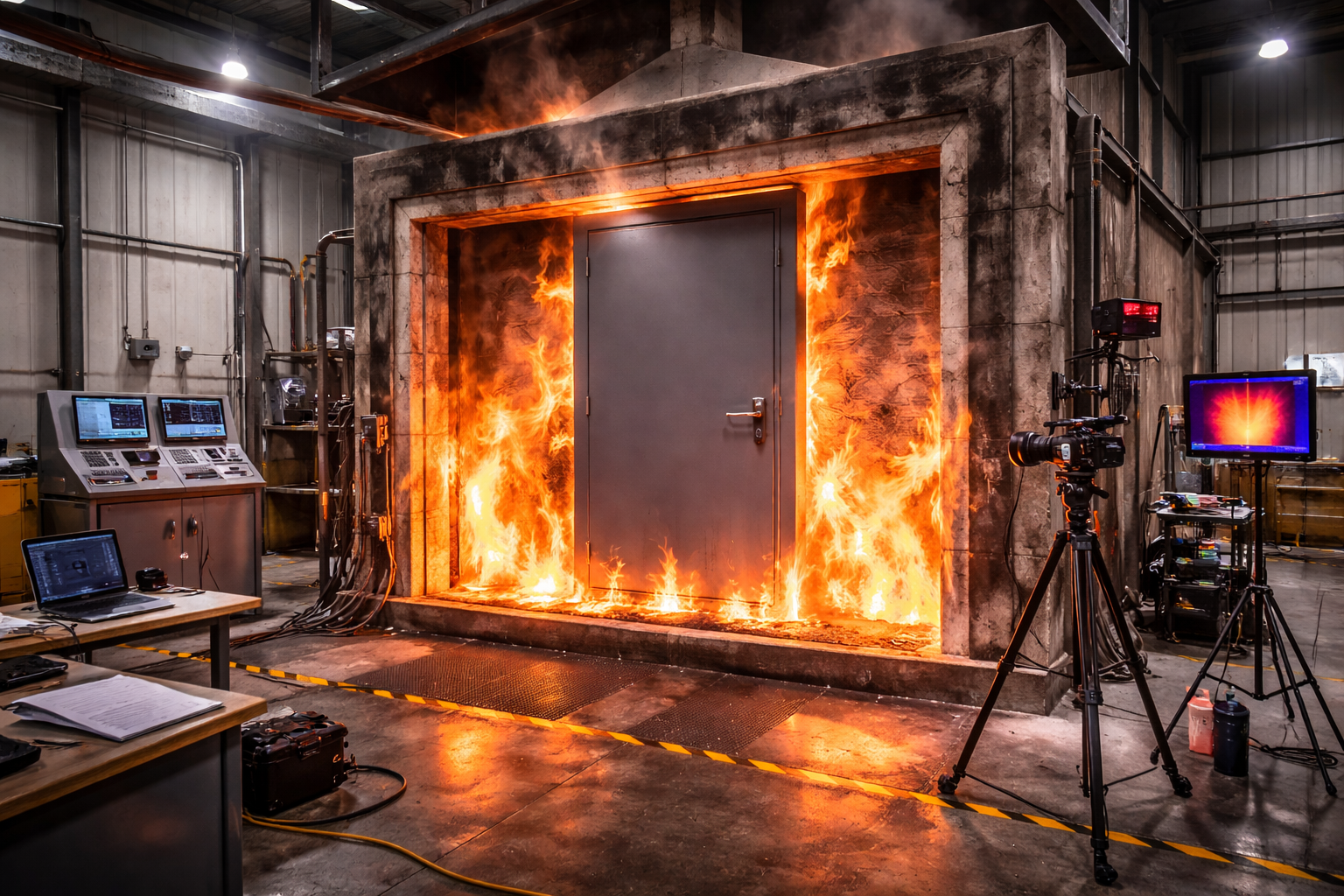
- BS EN 1634-1 – fire resistance test for door assemblies
- BS EN 1634-3 – smoke control / smoke leakage test
- BS EN 13501-2 – classification system for expressing fire resistance / smoke control results
- BS 8214:2016 – code of practice for specification, installation and maintenance of timber-based fire door assemblies
Routine fire door checks (what you should be looking for)
A practical, repeatable check typically includes:
- Does the door close fully onto the latch without sticking or slamming?
- Are the hinges secure and the door aligned in the frame?
- Are seals continuous and undamaged (not missing, loose, or painted over)?
- Is the self-closer working correctly (where fitted)?
- Is glazing intact and correctly beaded (if applicable)?
- Are there visible door/frame gaps that look excessive, or signs of warping/damage?
- Have unapproved modifications been made (e.g., letter plates, air transfer grilles, new ironmongery)?
For England’s higher-risk residential context (>11m), the government’s guidance sets out the expectation of quarterly communal checks and annual flat entrance door checks (best endeavours).
When should a fire door be repaired or replaced?
In general, you should escalate for a competent inspection if:
- the door won’t self-close and latch,
- seals are missing/damaged and can’t be reinstated correctly,
- the door leaf or frame is structurally damaged,
- ironmongery has been changed without suitable evidence,
- the door’s certification/traceability cannot be evidenced for the required use.
Need help with compliant fire doors?
Security Direct can help with:
- supply and installation of certified fire door assemblies (where applicable),
- remedial repairs (closers, hinges, latches, seals),
- planned inspection programmes and defect close-out support.
Call us or request a site survey and we’ll advise the practical next steps for your building type and risk profile.
Frequently Asked Questions
Are flat entrance doors (front doors to flats) included in fire safety duties?
Are flat entrance doors (front doors to flats) included in fire safety duties?
In England & Wales, the Fire Safety Act clarified that flat entrance doors are within scope for relevant buildings containing two or more domestic premises.
Do we have to check fire doors on a schedule?
Do we have to check fire doors on a schedule?
In England, for multi-occupied residential buildings over 11m, there are specific expectations: quarterly checks of communal fire doors and annual checks of flat entrance doors (best endeavours).
Is a “fire door leaf” on its own enough?
Is a “fire door leaf” on its own enough?
Usually not. Compliance relies on the tested door set / assembly (leaf + frame + seals + ironmongery + closer, installed to evidence). This is why “mix and match” installations often fail inspections.
Which standards matter most on certificates?
Which standards matter most on certificates?
Commonly: BS EN 1634 (test), BS EN 13501-2 (classification), and BS 8214 (installation/maintenance good practice).
View Our Fire Door Range


Choose your option


Choose your option


Steel Fire Exit Door
Choose your option


Doorway Fire Shutters - Flexible Structure
Choose your option


Choose your option


Choose your option


