

BS EN 1634-3 - Smoke Control Testing for Doors and Shutters
When protecting life in a fire, smoke is often the greatest danger, not flames.
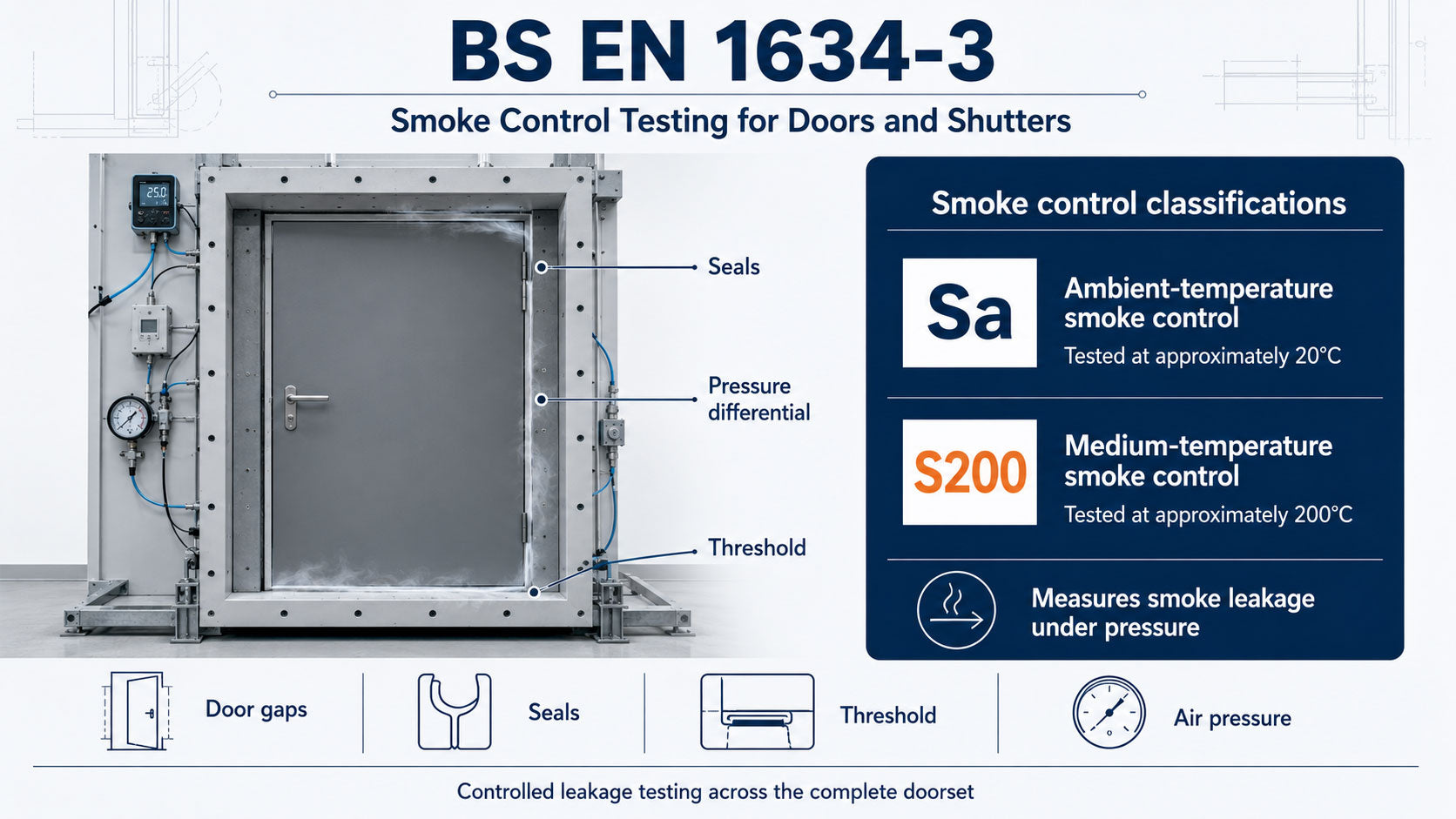
BS EN 1634-3 is the European test standard that measures the smoke leakage performance of door and shutter assemblies. It verifies whether a doorset can effectively restrict the passage of cold and medium-temperature smoke under controlled test conditions.
This standard is critical where doors protect escape routes, corridors, stairwells, and compartment lines.
Why Smoke Control Matters
In real fire incidents:
- Smoke spreads faster than flames
- Smoke inhalation is a leading cause of fatalities
- Visibility in escape routes can be lost within minutes
- Toxic gases travel through small gaps around doors
A door may resist fire for 60 minutes, but if smoke leaks around it early, escape safety is compromised.
BS EN 1634-3 exists to measure and classify this performance.
What BS EN 1634-3 Tests
Unlike BS EN 1634-1 (which tests fire resistance in a furnace),BS EN 1634-3 tests smoke leakage under ambient and elevated temperatures.
The test measures how much smoke passes through:
- Gaps between door leaf and frame
- Hardware penetrations
- Threshold areas
- Glazing interfaces
- Seal lines
The assembly is mounted in a test rig and exposed to controlled air pressure differentials that simulate smoke movement.
Smoke Classification Ratings
Results are classified using designations such as:
- Tested at approximately 20°C
- Assesses “cold smoke” leakage
- Most common requirement for escape route doors
- Tested at approximately 200°C
- Represents smoke conditions in developing fires
- Higher performance classification
If a door is described as:
EI60 SaIt means:
- 60 minutes fire resistance (integrity + insulation)
- Smoke leakage performance at ambient temperature
Fire resistance and smoke control are separate tests and must both be specified where required.
Where BS EN 1634-3 Is Typically Required
Smoke control performance is commonly required for:
- Protected escape corridors
- Stairwells
- Apartment entrance doors
- Hotel room doors
- Care homes and healthcare buildings
- Office compartmentation doors
In many projects, smoke seals are mandatory even when insulation performance is not.
Always confirm requirements in the building’s fire strategy.
BS EN 1634-3 vs BS EN 1634-1
- BS EN 1634-1 - Fire resistance
Measures how long a door resists fire exposure - BS EN 1634-3 - Smoke leakage
Measures how much smoke passes through a doorset
Both standards are often required together.
A door can pass fire resistance testing but fail smoke leakage testing if seals are inadequate.
The Importance of Smoke Seals
To achieve Sa or S200 classification, doorsets typically require:
- Intumescent smoke seals
- Brush or blade seals
- Threshold sealing systems
- Correct gap tolerances
Installation tolerances are critical. Excessive gaps can invalidate smoke performance even if the door is certified.
Compliance and Specification
BS EN 1634-3 is a test method, not legislation.However, it supports compliance with:
- Building Regulations (Approved Document B in England)
- Fire safety strategies
- The Regulatory Reform (Fire Safety) Order 2005
Many building control bodies and fire engineers specify Sa-rated doors as a minimum in protected routes.
Common Specification Example
A typical modern specification may read:
Steel Doorset – EI30 Sa
Meaning:
- 30 minutes fire resistance
- Smoke leakage control at ambient temperature
Always ensure test evidence and classification reports are available.
Need Advice on Smoke Control Doors?
If you are:
- Replacing apartment entrance doors
- Upgrading corridor doors
- Reviewing compliance in residential blocks
- Preparing documentation for building control
We can review certification, advise on correct ratings, and ensure compliant installation.
Contact us to discuss your project requirements.
Frequently Asked Questions
What does BS EN 1634-3 test?
What does BS EN 1634-3 test?
BS EN 1634-3 tests the smoke leakage performance of a complete door or shutter assembly.
It measures how much smoke passes through the doorset under controlled pressure conditions at:
- Ambient temperature (Sa classification)
- Approximately 200°C (S200 classification)
It does not test fire resistance — that is covered under BS EN 1634-1.
Is smoke control different from fire resistance?
Is smoke control different from fire resistance?
Yes.
A door can resist flames for 30 or 60 minutes but still allow smoke to leak through gaps.
- BS EN 1634-1 = Fire resistance (flames and heat)
- BS EN 1634-3 = Smoke leakage control
In protected escape routes, both are often required.
What does “Sa” mean?
What does “Sa” mean?
Sa means the doorset has been tested for smoke leakage at ambient (cold) temperatures.
This is the most common requirement for:
- Corridor doors
- Stairwell doors
- Apartment entrance doors
- Hotel and care home bedroom doors
It ensures the door restricts cold smoke movement during early fire stages.
What is the difference between Sa and S200?
What is the difference between Sa and S200?
- Sa = Smoke leakage tested at ambient temperature (~20°C)
- S200 = Smoke leakage tested at approximately 200°
CS200 represents performance in more developed fire conditions and is a higher classification.
Your fire strategy will determine which is required.
Can installation affect smoke performance?
Can installation affect smoke performance?
Absolutely.
Even if a door has valid BS EN 1634-3 certification, smoke performance can fail on site if:
- Gaps between leaf and frame are excessive
- Seals are missing or damaged
- Threshold sealing is incorrect
- Hardware has been changed outside tested scope
Correct installation tolerances and maintenance are critical to maintaining compliance.
View Our BS 1634-3 Range


Smoke Curtain- SC1 - Tested to BSEN 12101-1
Choose your option


