

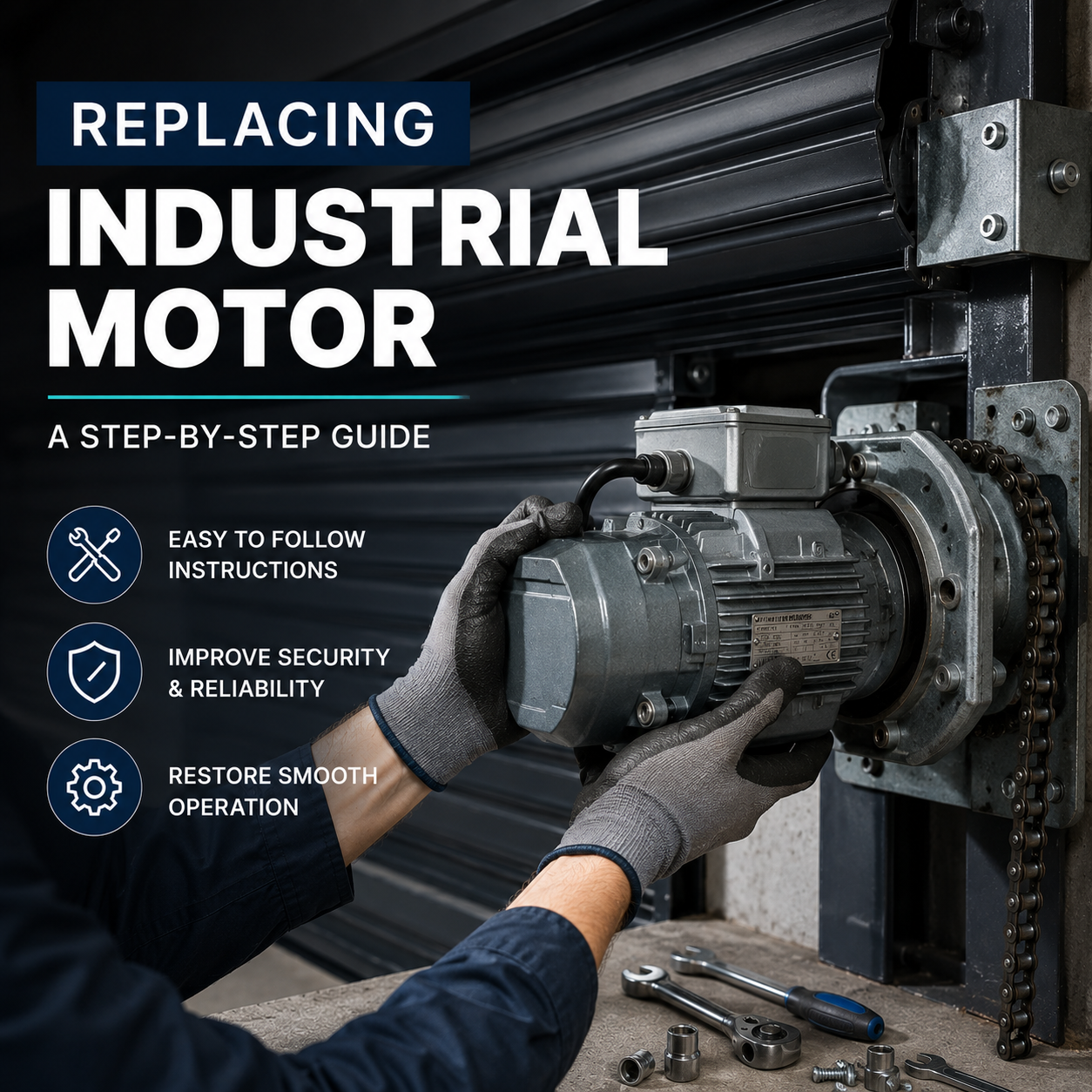
Replacing Industrial Motors
When Should You Replace an Industrial Motor?
Industrial motors are designed for heavy-duty roller shutters used on warehouses, factories, and large openings. Over time, these motors can wear out due to high usage, load, or electrical faults.
Common signs your motor may need replacing:
- Shutter not operating or stopping intermittently
- Slow or uneven movement
- Excessive noise from motor or gearbox
- Motor overheating or tripping
Replacing the motor can restore reliable operation, but it is important to ensure the replacement matches the existing system.
Replacing Industrial Motors
1. What Type of Motor Do You Have?
1. What Type of Motor Do You Have?
Industrial roller shutters typically use:
Single Phase Motors (240V)
- Suitable for lighter duty or lower usage
- Often used on smaller industrial doors
Three Phase Motors (415V)
- Designed for heavy-duty applications
- Suitable for large shutters or high-frequency use
Inboard Motors (Chain Driven)
- Mounted inside the endplates
- Use a chain to drive the barrel
Outboard Motors (Direct Drive)
- Mounted externally on the endplate
- Barrel passes directly through the motor
Understanding which type you have is essential before replacing.
2. Inboard vs Outboard Motors (Key Difference)
2. Inboard vs Outboard Motors (Key Difference)
Inboard Motors
- Chain driven system
- Lower initial cost
- More maintenance required
Outboard Motors
- Direct drive (no chain)
- More reliable and smoother operation
- Preferred for modern installations
3. Can You Upgrade?
3. Can You Upgrade?
In many cases, it is possible to upgrade or change an industrial roller shutter motor, but it is important to understand why you are upgrading and whether the rest of the door system is designed to accommodate the change. Simply fitting a larger or different motor does not always improve performance and can sometimes create operational or safety issues.
Upgrading to a Larger Motor
A larger motor is not usually required unless the existing motor has been incorrectly specified or the weight of the door has increased due to modifications. Industrial motors are carefully selected based on the curtain weight, axle size, duty cycle, and operating requirements of the door.
Installing a more powerful motor will not necessarily make the door stronger or more reliable. In fact, an oversized motor can place excessive stress on the axle assembly, barrel, suspension components, safety devices, and control equipment. Before upgrading motor size, it is important to establish the reason for the change and confirm that the entire door system is capable of handling the increased torque.
Increasing the Opening Speed
Some customers wish to upgrade to a faster motor to improve traffic flow or operational efficiency. While this can often be achieved, the door itself must be designed to operate at higher speeds.
Factors that need to be considered include:
- Curtain wind resistance and stability
- Guide rail design and wear characteristics
- Safety edge response times
- Brake performance
- Control panel compatibility
- Compliance with current machinery safety regulations
Operating a door faster than its original design specification can reduce component life and may compromise safety if the appropriate upgrades are not carried out at the same time.
Changing Between Single-Phase and Three-Phase Motors
Converting from a single-phase motor to a three-phase motor, or vice versa, is generally straightforward provided the correct power supply is available.
Many industrial motors are available in both single-phase and three-phase versions, allowing the motor and control equipment to be changed without major modifications to the door itself. Three-phase motors are often preferred for larger doors due to their smoother operation, improved efficiency, and higher duty cycle capabilities.
Changing from Inboard to Outboard Motors
Although it is technically possible to convert between inboard and outboard motor arrangements, this is rarely a simple motor swap.
The motor mounting system, axle assembly, support brackets, bearings, and drive arrangements are often completely different between the two designs. For this reason, if you wish to change from an inboard motor to an outboard motor (or vice versa), we would generally recommend replacing the complete axle assembly rather than attempting to adapt the existing components.
This ensures correct alignment, reliable operation, and long-term durability while avoiding compatibility issues during installation.
Our Recommendation
For most industrial roller shutters, the safest and most cost-effective solution is to replace the motor on a like-for-like basis using the same manufacturer and model wherever possible. Industrial motors are designed as part of a complete door system, and changing specifications without proper assessment can lead to performance, reliability, and safety concerns. If you are considering an upgrade, it is always worth discussing your requirements with a specialist before ordering replacement components.
4. Matching the Correct Motor (Very Important)
4. Matching the Correct Motor (Very Important)
When replacing an industrial motor, you must match:
- Motor type (single or three phase)
- Torque and lifting capacity
- Mounting configuration (inboard or outboard)
- Shaft and barrel compatibility
Using the wrong motor can lead to:
- Installation issues
- Poor performance
- Damage to the shutter system
Where possible, always replace like for like.
5. What If the Motor is Obsolete?
5. What If the Motor is Obsolete?
If the original motor is no longer available:
Option 1: Replace with a Compatible Motor
May require adapters or modifications
Option 2: Replace Full Axle Assembly (Recommended)
- Includes barrel, motor, and fittings
- Ensures full compatibility
- Faster and more reliable solution
6. Choosing the Correct Motor Size
6. Choosing the Correct Motor Size
Motor size is based on lifting capacity.
Key factors:
- Width and height of the shutter
- Curtain weight
- Frequency of use
- Type of application
Incorrect sizing can cause:
- Motor strain or failure
- Poor operation
- Increased wear
- Controls and Safety Features
Industrial motors can be used with:
- Push button stations
- Key switches
- Remote controls
- Automated systems
Safety Options:
- Safety edge (stops on contact)
- Light curtain systems
- Emergency stop
These are especially important on large industrial doors.
7. Information We Need to Supply the Correct Motor
7. Information We Need to Supply the Correct Motor
To help us identify the correct replacement, we will need:
- Photos of the motor and installation
- Motor type (single or three phase)
- Mounting type (inboard or outboard)
- Overall Shutter size (width and height)
- Usage level (daily cycles)
- Any motor labels or serial numbers
8. Step-by-Step Guide to Replacing an Industrial Motor
8. Step-by-Step Guide to Replacing an Industrial Motor
Replacing an industrial motor requires care due to the size and weight of the shutter system. For large doors, professional installation is recommended.
Step 1: Isolate the Power Supply
- Disconnect all electrical supply
- Ensure the shutter cannot be operated
- Confirm safe working condition
Step 2: Lower and Secure the Shutter
- Fully close the shutter
- Support the curtain if required
- Prevent movement during the repai
Step 3: Open the Shutter Box
- Remove the cover to access the motor and barrel
- Identify motor type and mounting setup
Step 4: Disconnect the Motor
- Disconnect electrical wiring
- Label connections if needed
- Isolate control systems
Step 5: Remove the Existing Motor
Inboard Motor:
- Remove chain drive
- Disconnect motor from barrel
Outboard Motor:
- Unbolt motor from endplate
- Slide motor off the shaft
Support the motor during removal, as it may be heavy.
Step 6: Inspect Barrel and Components
- Check shaft condition
- Inspect bearings and brackets
- Replace worn components if require
Step 7: Fit the New Motor
Inboard Motor:
- Reconnect chain drive
- Align motor within the endplate
Outboard Motor:
- Slide motor onto shaft
- Secure to endplate
Ensure:
- Correct alignment
- Secure fixing
- Proper engagement with the barrel
Step 8: Reconnect Wiring and Controls
- Reconnect electrical supply
- Ensure correct wiring configuration
- Check compatibility with controls
Step 9: Set Limits and Test Operation
- Set open and closed positions
- Run the shutter through full cycles
- Check for smooth, even operation
Ensure:
- No excessive noise
- Correct stopping points
- Safe operation
Step 10: Final Checks
- Tighten all fixings
- Confirm motor is secure
- Check safety features are working
- Refit shutter box cover
9. Technical Information
9. Technical Information
Compatibility and Fit
Industrial motors must match:
- Shaft size and type
- Endplate configuration
- Drive system (chain or direct drive)
Incorrect fit can lead to operational issues or failure.
Electrical Requirements
- Single phase (240V) or three phase (415V)
- Must be wired correctly
- Installed in line with electrical regulations
When to Replace the Full System
Consider a full replacement if:
- Motor is obsolete
- Barrel or shaft is worn
- System is unreliable
- Upgrading from inboard to outboard
Maintenance Tips
- Regularly check motor operation
- Inspect chains (inboard systems)
- Test safety systems
- Schedule routine servicing
Shop Our Industrial Motors

GfA GA 17.15 SI Safedrive Direct Drive Industrial Motor - Three Phase
Choose your option

GfA GA 25.15 SI Safedrive Direct Drive Industrial Motor - Three Phase
Choose your option

GfA GA 25.15WS SI Safedrive Direct Drive Industrial Motor - Single Phase
Choose your option
GfA GA 35.15 SI Safedrive Direct Drive Industrial Motor - Three Phase
Choose your option

GfA GA 45.7 SI Safedrive Direct Drive Industrial Motor - Single Phase
Choose your option

GfA GA 45.15 SI Safedrive Direct Drive Industrial Motor - Three Phase
Choose your option
GfA GA 55.15 SI Safedrive Direct Drive Industrial Motor - Three Phase
Choose your option
GfA GA 65.15 SI Safedrive Direct Drive Industrial Motor - Three Phase
Choose your option
Still Need Help? Contact Our Team, Today!
Need Help Identifying the Right Motor?
If you are unsure what motor you need, our team can help you identify the correct replacement or upgrade.
Speak to Our Team
We can advise on the correct motor type and whether an upgrade is suitable.
Send Us Photos or Details
Send us images and specifications, and we will match the correct motor for your shutter.
Request a Quote
We can provide a clear, no-obligation quote for replacement motors or full system upgrades.


