

Fire Shutter & Fire Curtain Regulations Explained (UK)
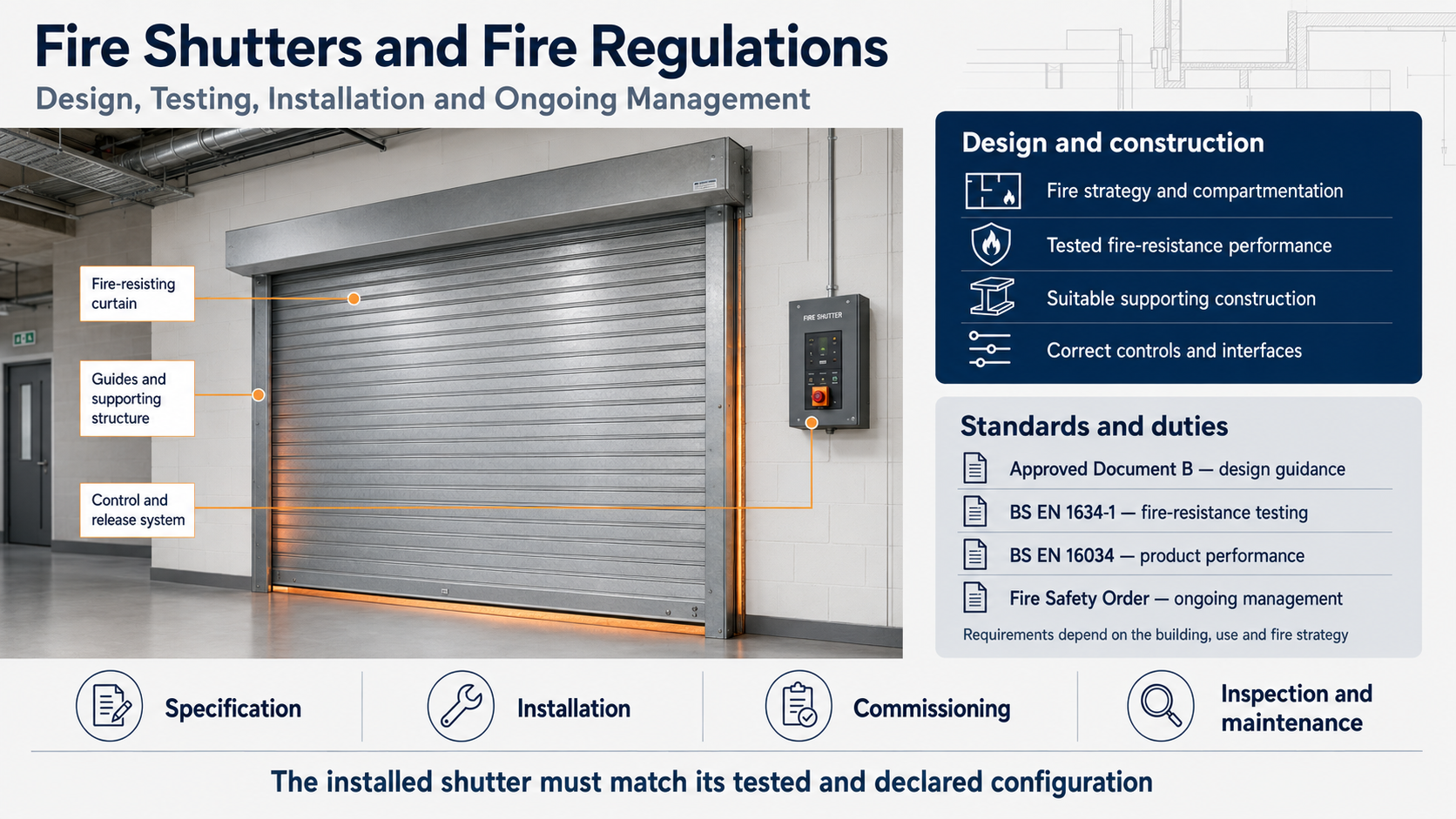
Fire Shutters, Fire Curtains & Smoke Curtains
Fire shutters and fire curtains play a critical role in compartmentation and life safety within UK buildings. However, the regulations, test standards and fire ratings can be complex and are often misunderstood.
This guide explains the relevant UK legislation, testing standards, certification schemes and fire resistance ratings that apply to:
The Legal Framework in the UK
The Regulatory Reform (Fire Safety) Order 2005
This is the primary fire safety legislation in England and Wales. It requires the “Responsible Person” (building owner or operator) to:
- Conduct a fire risk assessment
- Implement appropriate fire safety measures
- Maintain fire protection systems
Fire shutters and curtains are considered part of the building’s passive fire protection system and must be properly maintained.
Building Regulations – Approved Document B
Approved Document B (ADB) provides guidance on meeting Building Regulations in relation to fire safety.
Fire shutters and curtains are typically used for:
- Compartmentation
- Protecting escape routes
- Separating high-risk areas
- Closing openings in fire-resisting walls
They must achieve defined fire resistance performance levels based on the building design strategy.
Key Fire Testing Standards (UK & European)
This is the primary test standard for:
- Fire shutters
- Fire resisting doors
- Fire curtains used as fire barriers
The product is exposed to a furnace test simulating real fire conditions to determine how long it can resist fire.
The result is expressed as a time rating in minutes.
BS EN 16034 is the harmonised product standard that works alongside BS EN 1634.
It covers:
- Fire resistance
- Smoke control (if applicable)
- Self-closing ability
- Durability
Products tested to BS EN 1634 and compliant with EN 16034 may be CE/UKCA marked.
BS 8524 is a dedicated British Standard specifically for active fire curtain barrier assemblies.
This is an important distinction.
Whereas BS EN 1634 is a fire resistance test method, BS 8524 addresses the wider performance of active fire curtain systems installed in real buildings.
It covers areas such as:
- System reliability
- Deployment performance
- Durability
- Operational behavior
- Ancillary components and controls
- Installation and maintenance guidance
BS 8524 is split into:
- BS 8524-1 – Specification (performance requirements for the system)
- BS 8524-2 – Code of Practice (application, installation and maintenance guidance)
For fire curtains used as active barriers in UK buildings, BS 8524 is a key reference standard.
This standard applies to smoke control systems, including smoke curtains.
It assesses:
- Smoke containment performance
- Deployment reliability
- Temperature classification
- Durability
Smoke curtains are not designed to stop fire, they are designed to control smoke movement.
Fire Shutters – Testing & Ratings
Fire shutters are typically steel roller shutters used to protect openings in fire-resisting walls.
- BS EN 1634-1
- Classified under BS EN 13501-2
- May fall under BS EN 16034 product standard
- E60
- E120
- EI60
- EI120
- Commercial kitchens
- Warehouses
- Industrial units
- Service penetrations
- Compartment walls
- Fusible links
- Fire alarm interface
- Battery backup systems with controlled descent
Fire Curtains – Testing & Compliance
Fire curtains are fabric-based barrier systems that deploy automatically.
- Fire resistance testing to BS EN 1634-1
- Classification under BS EN 13501-2
- Active system performance referenced to BS 8524
Fire curtains are widely used in:
- Shopping centres
- Schools
- Office buildings
- Atriums
- Open-plan layouts
Their ability to remain hidden within ceiling voids makes them ideal where aesthetics are important.
Fire & Smoke Curtains
Fire & smoke curtains combine:
- Fire resistance
- Smoke containment
Depending on design and function, they may require compliance with:
- BS EN 1634-1 (fire resistance)
- BS EN 12101-1 (smoke control)
- BS 8524 (active fire curtain systems)
Specification depends on the building’s fire strategy.
Smoke Curtains (Non-Fire Rated)
Smoke curtains are designed purely for smoke management.
Tested To:
- BS EN 12101-1
They are commonly used for:
- Smoke reservoirs
- Protecting escape routes
- Supporting smoke extraction systems
They are not designed to provide fire resistance unless specifically tested and classified for that purpose.
Choosing the Correct Fire Rating
The required rating is determined by the building’s fire strategy and risk assessment.
Factors include:
- Building height
- Compartment size
- Occupancy type
- Escape strategy
- Risk level
Typical examples:
- Kitchen separation - E60 or EI60
- Warehouse compartment wall - E120Escape corridor protection EI60
- Atrium smoke control - Smoke curtain (BS EN 12101-1)
Final specification should align with the fire engineer’s design.
Maintenance & Legal Responsibility
Under the Fire Safety Order, the Responsible Person must ensure:
- Systems remain operational
- Annual servicing is carried out (minimum)
- Regular functional testing is completed
- Maintenance records are kept
Where connected to fire alarm systems, shutters and curtains should form part of routine alarm testing procedures.
Failure to maintain fire protection systems can invalidate compliance and insurance.
Common Misconceptions
“A fire curtain only needs to pass a fire test.”
Active fire curtain systems must also demonstrate reliability and operational performance, which is where BS 8524 becomes relevant.
“Smoke curtains stop fire.”
Smoke curtains manage smoke, not fire, unless specifically tested for fire resistance.
“Installation does not affect compliance.”
Incorrect — installation must follow the tested configuration and relevant standards.
“Servicing is optional.”
All fire protection systems must be inspected and maintained.
Frequently Asked Questions
What is the difference between E and EI fire rating?
What is the difference between E and EI fire rating?
EI includes insulation performance, offering greater protection than E alone.
Are fire curtains compliant without BS 8524?
Are fire curtains compliant without BS 8524?
Fire resistance testing alone does not address system reliability. For active curtain systems in UK buildings, BS 8524 is an important reference standard.
Do smoke curtains need fire ratings?
Do smoke curtains need fire ratings?
No, unless they are designed to act as fire barriers.
How often must fire shutters and curtains be serviced?
How often must fire shutters and curtains be serviced?
They should be serviced at least annually, with regular functional testing as part of the building’s fire safety regime.
Are fire shutters required to connect to the fire alarm?
Are fire shutters required to connect to the fire alarm?
In many commercial installations, yes — this depends on the fire strategy.
Are fire rated shutters always electric?
Are fire rated shutters always electric?
Yes. Fire shutters require a power supply in order to operate correctly and safely in modern commercial installations.
While older systems sometimes used fusible links to trigger a gravity drop, current fire shutter systems are electrically operated so they can integrate with the building’s fire alarm system. This allows controlled activation, monitored status, and safe descent in the event of a fire.
Even where a shutter closes by gravity, it still requires electrical power for normal operation and is typically fitted with battery backup to ensure it will deploy in the event of mains power failure.
View Our Fire Rated Products


Choose your option


Choose your option


Steel Fire Exit Door
Choose your option


Doorway Fire Shutters - Flexible Structure
Choose your option


Choose your option


Choose your option


