

Approved Document B
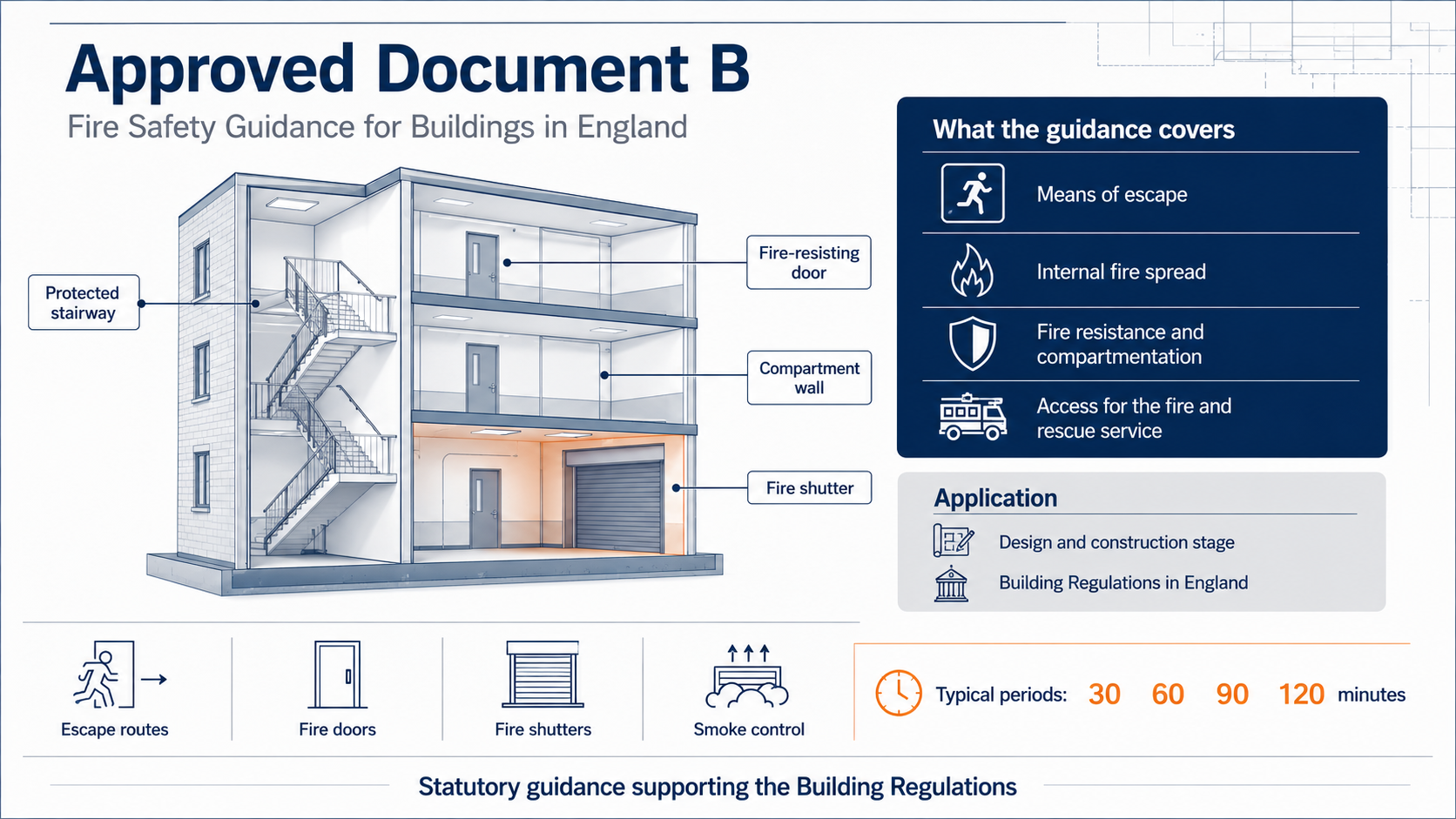
Approved Document B (ADB) is the official fire safety guidance supporting the Building Regulations in England.
It sets out practical guidance for meeting the legal requirements of:
Building Regulations 2010 – Requirement B (Fire Safety)
While ADB itself is not law, it is the primary reference used by:
- Building Control
- Fire engineers
- Architects
- Main contractors
- Developers
If you are installing or replacing fire doors or fire shutters, ADB is the starting point.
What Approved Document B Covers
ADB provides guidance on:
- Means of escape
- Internal fire spread (linings and structure)
- Compartmentation
- Fire resistance periods
- Protection of escape routes
- Smoke control
- Fire door requirements
It defines where fire-resisting doors and shutters are required and what level of performance they must achieve.
Where Fire Doors Are Required Under ADB
Fire doors are typically required in:
- Protected Stairways
To keep escape routes clear of smoke and fire. - Protected Corridors
Common in flats, hotels, offices and care homes. - Compartment Walls
To maintain fire separation between areas of a building. - Flats and Apartment Entrance Doors
Front doors to flats opening onto common corridors or stairs. - Service Risers & Plant Rooms
To contain fire risk in higher hazard areas.
Fire Resistance Periods Under ADB
ADB defines required fire resistance in minutes, depending on:
- Building height
- Building use (residential, office, industrial etc.)
- Location within the structure
- Compartment size
Typical ratings include:
- FD30 / EI30 – 30 minutes
- FD60 / EI60 – 60 minutes
- FD90 / EI90 – 90 minutes
- FD120 / EI120 – 120 minutes
The correct rating must match the building’s fire strategy.
Smoke Control Requirements
ADB often requires doors protecting escape routes to provide:
- Cold smoke control (Sa classification)
This is why many fire doors must comply with:
- BS EN 1634-1 (fire resistance)
- BS EN 1634-3 (smoke leakage)
Smoke performance is critical in corridors and stair cores.
Fire Shutters Under Approved Document B
Fire shutters are commonly used where:
- Large openings require protection
- Commercial or industrial buildings have open-plan layouts
- Compartment lines run through loading bays or warehouse spaces
- Openings are too large for conventional fire doors
ADB requires shutters to:
Provide the same fire resistance period as the wall they protect
Be tested and classified appropriately
Deploy automatically where required
They are frequently used in:
- Industrial units
- Retail spaces
- Schools
- Shopping centres
- Mixed-use developments
Compartmentation Principles
ADB is built around the concept of compartmentation.
Buildings are divided into fire-resisting compartments to:
- Slow fire spread
- Protect escape routes
- Protect structural integrity
- Limit property damage
Fire doors and shutters are critical components of this compartment strategy.
If a door or shutter fails, the compartment fails.
Installation Matters
ADB assumes that fire doors and shutters are:
- Installed in accordance with test evidence
- Fitted with correct hardware
- Properly sealed
- Self-closing where required
- Maintained in working order
Incorrect installation can invalidate performance and lead to Building Control issues.
Approved Document B vs Fire Safety Law
It is important to understand the difference:
- Construction / Refurbishment
Building Regulations (ADB guidance) - Ongoing Occupation
Fire Safety Order 2005
ADB applies at design and construction stage.
Ongoing maintenance falls under fire safety legislation.
England vs Scotland vs Northern Ireland
Approved Document B applies in England.
Other regions use:
- Scotland – Technical Handbook (Section 2)
- Northern Ireland – Technical Booklet E
Requirements are broadly similar but not identical.
Common Compliance Mistakes
We frequently see:
- Incorrect fire resistance ratings installed
- Doors missing smoke seals
- Gaps outside permitted tolerances
- Hardware substituted outside tested scope
- Fire shutters without correct activation controls
- Missing certification documentation
All can create compliance risks.
Need Advice on ADB Compliance?
If you are:
- Planning a refurbishment
- Replacing apartment entrance doors
- Installing commercial fire shutters
- Preparing documentation for Building Control
We can review your specification and confirm compliant fire door and shutter solutions.
Contact us to discuss your project.
Frequently Asked Questions
Is Approved Document B a legal requirement?
Is Approved Document B a legal requirement?
Approved Document B (ADB) itself is guidance, not legislation.
However, it supports compliance with the Building Regulations 2010 (Requirement B – Fire Safety). If you follow ADB guidance, Building Control will generally accept that you have met the legal requirements.
Alternative fire-engineered solutions are permitted, but they must demonstrate equivalent safety.
How do I know what fire rating my doors or shutters need?
How do I know what fire rating my doors or shutters need?
The required fire resistance depends on:
- Building height
- Building use (residential, office, industrial, etc.)
- Location within the building (stair core, corridor, plant room)
- Compartment size
Typical requirements are FD30 (30 minutes) or FD60 (60 minutes), but higher ratings may be required in taller or higher-risk buildings.
This should align with the project’s fire strategy and Building Control approval.
Do fire doors under Approved Document B need smoke seals?
Do fire doors under Approved Document B need smoke seals?
In most cases, yes — particularly where doors protect:
- Escape corridors
- Stairways
- Apartment entrance doors
ADB commonly requires smoke control performance (often Sa classification), meaning doors must also comply with smoke leakage testing under BS EN 1634-3.
Fire resistance alone is often not sufficient.
Are fire shutters treated the same as fire doors under ADB?
Are fire shutters treated the same as fire doors under ADB?
They serve the same purpose — maintaining compartmentation — but are typically used for:
- Large openings
- Industrial or commercial settings
- Open-plan areas
A fire shutter must provide the same fire resistance period as the wall it protects and must be tested and classified appropriately.
Automatic deployment and correct activation systems are also important.
Does Approved Document B apply after the building is completed?
Does Approved Document B apply after the building is completed?
ADB primarily applies during design, construction and refurbishment.
Once the building is occupied, ongoing responsibilities fall under:
- The Regulatory Reform (Fire Safety) Order 2005
- Fire Safety (England) Regulations 2022 (where applicable)
This means fire doors and shutters must also be properly maintained and inspected after installation.


