

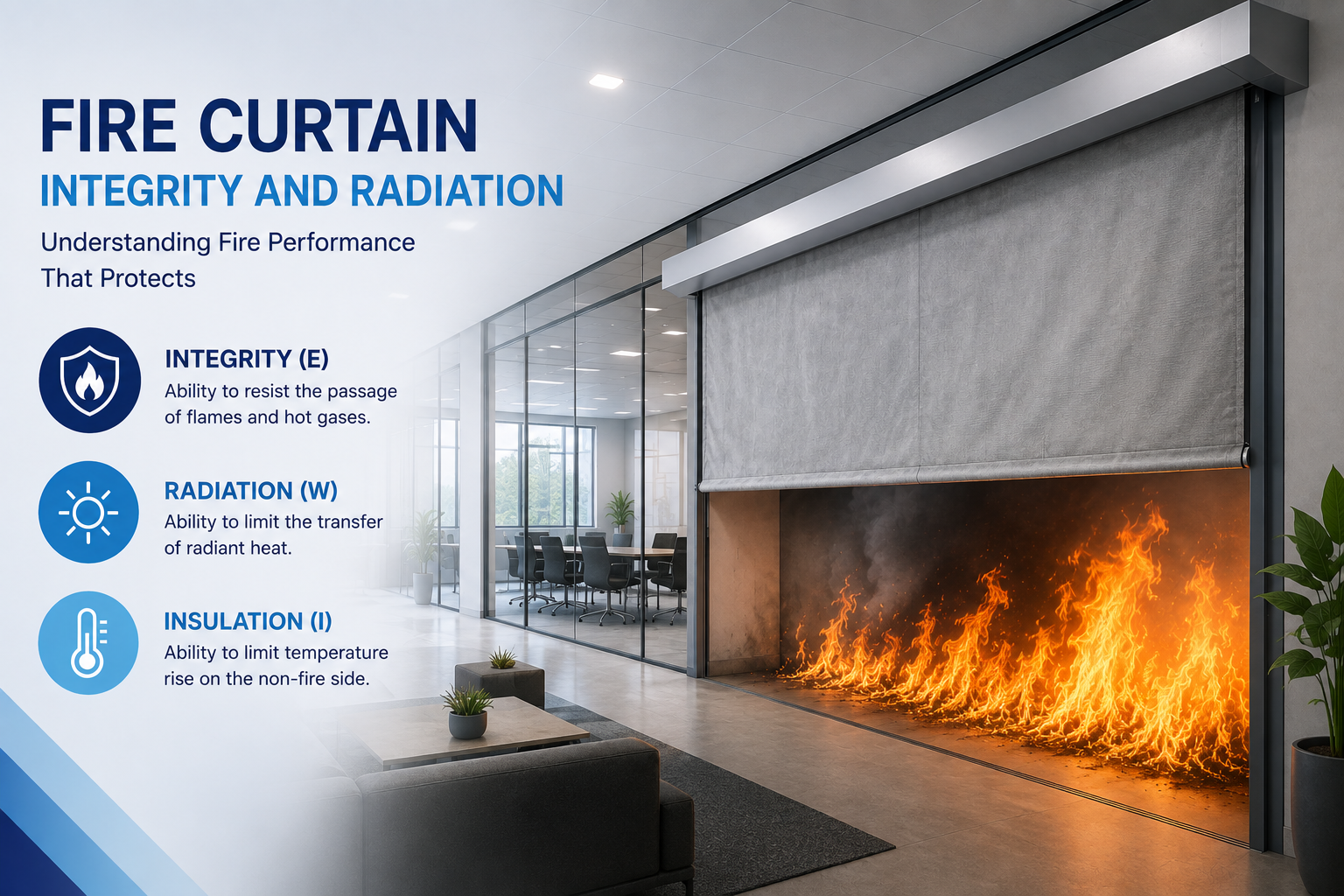
When specifying fire curtains for a building, you may come across terms such as integrity, radiation and insulation. These classifications describe different aspects of how a fire curtain performs when exposed to fire and can be important when determining which solution is appropriate for a particular application.
Understanding the difference is especially important because not all fire curtains provide the same level or type of protection. A curtain may provide excellent fire integrity but have a different performance when it comes to limiting heat radiation.
In this guide, we explain fire curtain integrity and radiation, what the different classifications mean and why they matter when choosing a fire curtain.
What Is a Fire Curtain?
A fire curtain is a specially designed barrier that deploys to help restrict the spread of fire and smoke through a building.
Unlike a traditional fire door or fire shutter, a fire curtain can normally remain discreetly housed above an opening until it is required. When activated by the building's fire detection or alarm system, the curtain descends to create a fire-resistant barrier.
This makes fire curtains particularly useful in locations where maintaining an open-plan appearance or unrestricted access during normal use is important.
Typical applications can include:
- Shopping centres and retail premises
- Offices
- Hotels
- Schools and universities
- Hospitals and healthcare environments
- Apartment buildings
- Open-plan commercial buildings
- Doorways, corridors and lift openings
However, the required performance of the curtain will depend on the building and its fire strategy.
What Does Fire Curtain Integrity Mean?
Integrity refers to the ability of the fire curtain to resist the passage of flames and hot gases from the fire side of the barrier to the protected side for a specified period.
You may see integrity performance expressed with an E classification followed by a period of time.
For example, a fire curtain could have a classification indicating that its integrity has been demonstrated for a particular number of minutes under the relevant test conditions.
In simple terms, integrity is concerned with the curtain continuing to act as an effective physical barrier against fire.
This is one of the fundamental performance characteristics to consider when specifying a fire curtain.
What Does Radiation Mean on a Fire Curtain?
Stopping flames from passing through an opening is only part of fire protection.
Even when a fire curtain maintains its integrity, significant radiant heat can potentially be transmitted from the fire side of the curtain.
Radiation performance relates to the curtain's ability to limit this heat radiation on the protected side.
This is important because excessive radiant heat can affect people, combustible materials and escape routes even where flames have not passed through the barrier.
A fire curtain with a radiation classification is therefore designed and tested to provide a specified level of protection against radiant heat in addition to maintaining its integrity.
Integrity vs Radiation – What's the Difference?
The easiest way to understand the difference is to think about what each performance characteristic is protecting against.
- Integrity (E) relates primarily to preventing flames and hot gases from passing through the fire barrier.
- Radiation (W) relates to limiting the amount of radiant heat transmitted through the barrier.
A curtain can therefore maintain its physical integrity while the temperature and radiant heat on the non-fire side continue to increase.
This is why simply asking “How many minutes is the fire curtain rated for?” doesn't always provide enough information.
The required classification needs to be considered alongside the specific application and the building's fire strategy.
What About Insulated Fire Curtains?
You may also encounter an insulation classification, commonly represented by I.
Insulation performance goes further than integrity by controlling the temperature rise on the non-fire side of the barrier within defined limits under the applicable test standard.
This is different from radiation control, so the terms integrity, radiation and insulation should not be used interchangeably.
Depending on the building design and fire strategy, an application may require integrity only or additional radiation or insulation performance.
Why Does Radiation Matter?
Radiant heat can travel across an area without direct contact with flames.
In a severe fire, sufficiently high levels of radiant heat can potentially make areas uncomfortable or unsafe for occupants and may contribute to the ignition of combustible materials.
Controlling radiation can therefore be particularly relevant where a fire curtain is being used near:
- Escape routes
- Areas occupied by people
- Combustible materials
- Building contents
- Large open spaces
- Areas requiring separation as part of the fire strategy
Whether radiation performance is required should be determined by the building's fire strategy and the relevant fire safety professionals rather than assumed from the application alone.
How Long Do Fire Curtains Provide Protection?
Fire curtain performance is normally classified according to testing against recognised standards, with performance stated for specified periods.
The appropriate duration isn't simply a matter of choosing the curtain with the longest available rating. The required performance should be determined by factors including the building design, location of the curtain and overall fire strategy.
When comparing products, it is therefore important to look at the complete fire classification, rather than comparing products solely by the number of minutes shown in their specifications.
Fire Curtains, Fire Shutters or Fire Doors?
A fire curtain isn't the only way of providing fire separation within a building.
Depending on the opening and how it is used, a fire roller shutter may provide a more suitable solution for larger openings where a robust physical shutter is required.
For pedestrian access and compartmentation, a steel fire door may be more appropriate.
Fire curtains are particularly beneficial where architectural appearance, available space or maintaining an open area during everyday use is important.
Choosing between these products should ultimately be based on the building's fire strategy and the required performance rather than appearance or price alone.
Choosing the Right Fire Curtain
There is no single fire curtain specification suitable for every building.
Before selecting a product, it is important to establish the required fire performance, size of the opening, method of activation, installation arrangement and how the curtain will integrate with the building's wider fire safety systems.
At Security Direct, we supply a range of fire curtains for different commercial and architectural applications. Our technical sales team can help you understand the available options and identify a suitable product based on your specified requirements.
For projects where a particular fire classification is required, always refer to the product's current test evidence, certification and technical documentation and ensure the proposed solution satisfies the project's fire strategy.
Need Help Choosing a Fire Curtain?
If you're unsure about fire curtain integrity and radiation ratings, speak to our technical sales team before placing an order.
We can discuss your opening, required classification and application and help you identify the most appropriate solution from our range of fire protection products.


