


Fire Shutter Buyers Guide
If you are looking to buy or specify a fire shutter, it is essential that the product is selected based on your building’s Fire Risk Assessment.
If you are unsure, you should always consult:
- The person responsible for your fire risk assessment
- Your local fire officer
- Building Control
Fire shutters are not just a product choice. They are part of a building’s overall fire safety strategy, and getting this wrong can lead to serious compliance issues.
Key Benefits:
- Fire shutters are designed to contain fire and protect escape routes
- They must close automatically in the event of a fire
- Most modern systems are electrically operated and linked to fire alarms
- Additional safety features are required for escape routes and public access areas
- Installation must meet strict requirements for substrates, fixings, and certification
Buyers Guide Fire Shutters
1. What is a Fire Shutter?
1. What is a Fire Shutter?
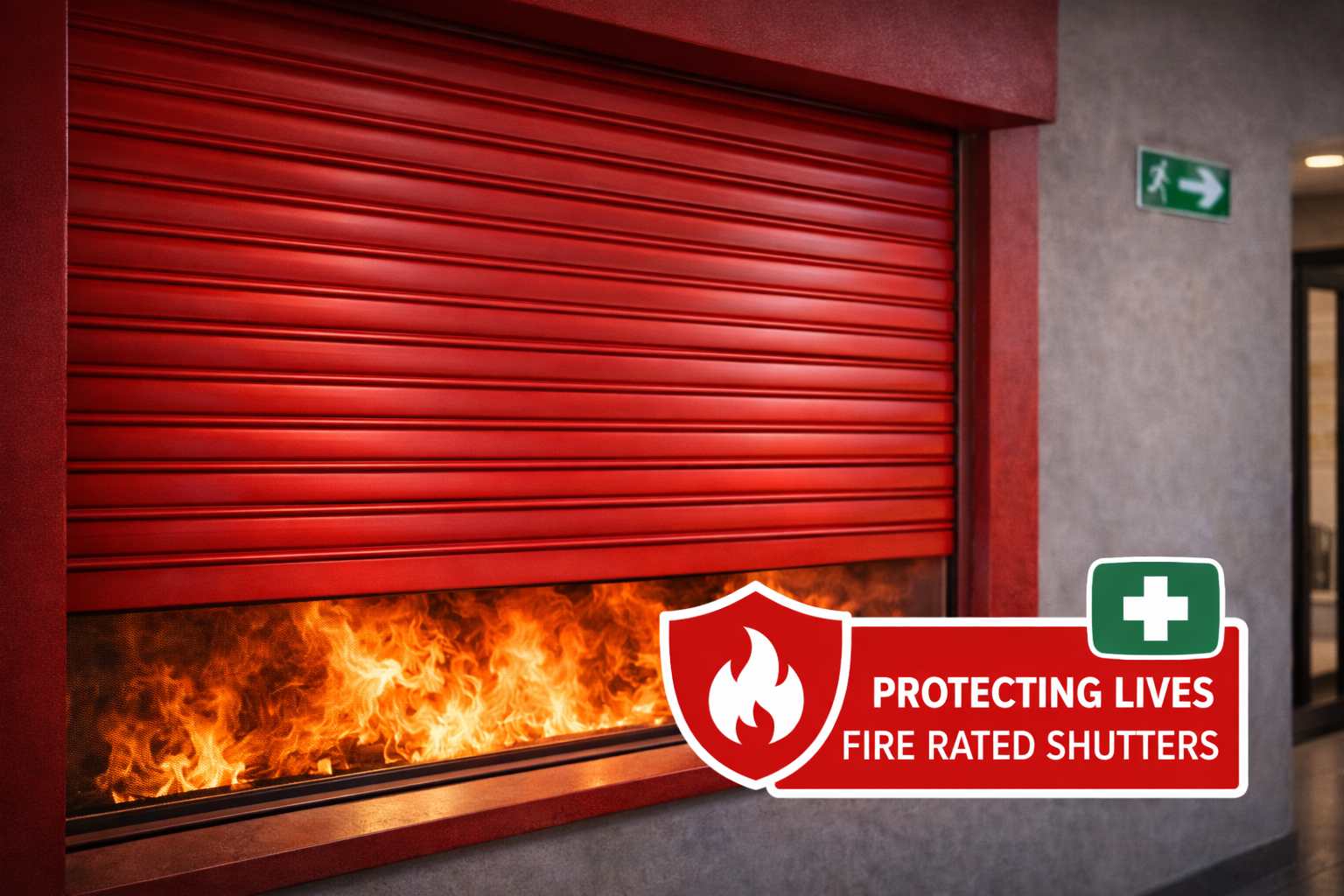
Fire shutters are specialist roller shutters designed to automatically close in the event of a fire, helping to contain fire and protect escape routes within a building.
They form part of a building’s passive fire protection system, working alongside fire alarms and compartmentation strategies.
Fire shutters are typically used to:
- Prevent the spread of fire between areas
- Protect escape routes
- Create fire-resistant barriers
They are commonly installed in commercial kitchens, serveries, and openings within fire-rated walls.
2. Types of Fire Shutters
2. Types of Fire Shutters
Fire shutters are available in different configurations depending on the application.
Compact Fire Shutters
- Smaller box size
- Ideal for standard door openings
- Neater appearance for internal use
Industrial Fire Shutters
- Larger and heavier duty
- Suitable for wide or tall openings
- Use more powerful motors
Fire and Security Shutters
- Combine fire resistance with enhanced security
- Suitable for higher-risk environments
Fire Curtains (Alternative Option)
- Used where space is limited
- Designed primarily for fire and smoke control
3. How to Choose the Right Fire Shutter
3. How to Choose the Right Fire Shutter
Choosing the correct fire shutter is critical and must be based on your building’s fire strategy.
Key considerations:
Fire Risk Assessment
- Determines whether a fire shutter is required
- Location of Installation
- Doorway, servery, or escape route
Means of Escape
- Additional safety features may be required
Purpose
- Fire compartmentation or refuge protection
Size of Opening
- May determine compact or industrial type
Always consult:
- Fire risk assessment
- Building Control
- Fire officer
4. Operation Options
4. Operation Options
Fire shutters are electrically operated and designed to function automatically in a fire.
Standard Operation
- Electric motor operation
- Daily use for security if required
Fire Activation
- Automatically closes when triggered by:
- Fire alarm system
- Independent heat detector
Safety Features
- Audio/visual warning systems
- Emergency escape buttons
- Staged descent options
These features are especially important when shutters are installed on escape routes.
5. Materials & Build Quality
5. Materials & Build Quality
Fire shutters are built using materials tested for fire resistance.
Typical Construction:
- Steel curtain and components
- Fire-rated motor and controls
Integrated safety brake system
Key Features:
- Tested to fire standards such as BS EN 16034
- Designed to withstand high temperatures
Built to maintain integrity during a fire
All components must be part of a tested system to ensure compliance.
6. Design & Customisation
6. Design & Customisation
Fire shutters can be tailored to suit both functional and aesthetic requirements.
Configuration Options:
- Compact or industrial designs
- Internal or external installation
Colour and Finish:
- Galvanised finish as standard
- Powder coating available in a wide range of colours
Additional Options:
- Integration with fire alarm systems
- Custom control systems
- Staged descent programming
Customisation must not compromise fire certification.
7. Installation Options
7. Installation Options
Correct installation is critical for fire performance and compliance.
Installation Requirements:
- Must be installed into masonry or structural steel
- Supporting structure must match fire rating
- Installed in line with tested specifications
Key Considerations:
- Clearance for expansion during fire
- Correct fixing methods
- Integration with fire alarm system
Installation must be carried out correctly to ensure certification remains valid.
8. Maintenance & Life Span
8. Maintenance & Life Span
Fire shutters require regular testing and maintenance.
Typical Maintenance:
- Weekly operational checks
- Testing fire alarm integration
- Checking battery backup systems
Life Span Factors:
- Frequency of use
- Environmental conditions
- Maintenance schedule
Regular maintenance is essential to ensure the shutter will operate correctly in an emergency.
9. Price Guide
9. Price Guide
The cost of fire shutters depends on:
- Size of the opening
- Type (compact or industrial)
- Control systems and safety features
- Installation requirements
General Pricing Guidance:
- Fire shutters are more expensive than standard shutters
- Additional safety features increase cost
- Larger or more complex systems require higher investment
Compact Fire Roller Shutters (Smaller Openings)
Typically used for kitchen serveries, counters, and internal compartment openings.
- Supply only: From £1,800 – £3,000
- Supplied and installed: From £3,000 – £5,000
Suitable for smaller spans with compact barrel assemblies.
Industrial Fire Roller Shutters (Larger Openings)
Designed for warehouses, factories, and loading bays.
- Supply only: From £3,500 – £6,000
- Supplied and installed: From £6,000 – £10,000+
Pricing increases significantly with width, height, and fire resistance rating.
10. Common Mistakes to Avoid
10. Common Mistakes to Avoid
- Not referring to the fire risk assessment
- Installing fire shutters without correct safety features
- Using incorrect substrates or fixings
- Not connecting to a fire alarm or heat detector
- Assuming fire shutters provide smoke protection
- Ignoring maintenance and testing requirements
Fire shutters are safety-critical systems and must be specified and installed correctly
FAQs - Fire Rated Roller Shutters
1. What fire rating do I need?
1. What fire rating do I need?
This depends on your building’s fire risk assessment and fire strategy.
2. Can a fire shutter be installed on an escape route?
2. Can a fire shutter be installed on an escape route?
Yes, but additional safety features are required and must be risk assessed.
3. Do fire shutters stop smoke?
3. Do fire shutters stop smoke?
No. They are designed to stop fire, not smoke.
4. Can I install a fire shutter into a stud wall?
4. Can I install a fire shutter into a stud wall?
Not directly. A structural steel subframe is usually required.
5. Do fire shutters need regular testing?
5. Do fire shutters need regular testing?
Yes. Regular checks are required to ensure compliance and safe operation.
6. Need Help Specifying a Fire Shutter?
6. Need Help Specifying a Fire Shutter?
If you are unsure what you need, our team can help you specify the correct system based on your building and application.
Bestselling Products - Fire Shutters


Servery Fire Shutters - Flexible Structure
Choose your option


Choose your option


Doorway Fire Shutters - Flexible Structure
Choose your option

Choose your option


Industrial Fire Shutters
Choose your option
Need to Talk to Our Team?
Choosing the right fire shutter is critical for safety, compliance, and long-term performance. If you are unsure what specification you need, our team can guide you through the process and ensure you get the correct solution for your building.
Speak to Our Team
Our experienced team can provide practical advice based on your application, building type, and fire risk requirements. Whether you are at early planning stage or ready to proceed, we can help you make the right decision.
Send Us Your Drawings
If you have drawings, plans, or opening sizes, send them over and we will review them for you. We can recommend the correct fire shutter specification, highlight any potential issues, and ensure everything aligns with compliance requirements.
Request a Quote
We can provide a clear, no-obligation quote based on your exact requirements. Where needed, we can also arrange a site survey to ensure accurate pricing and specification.


