

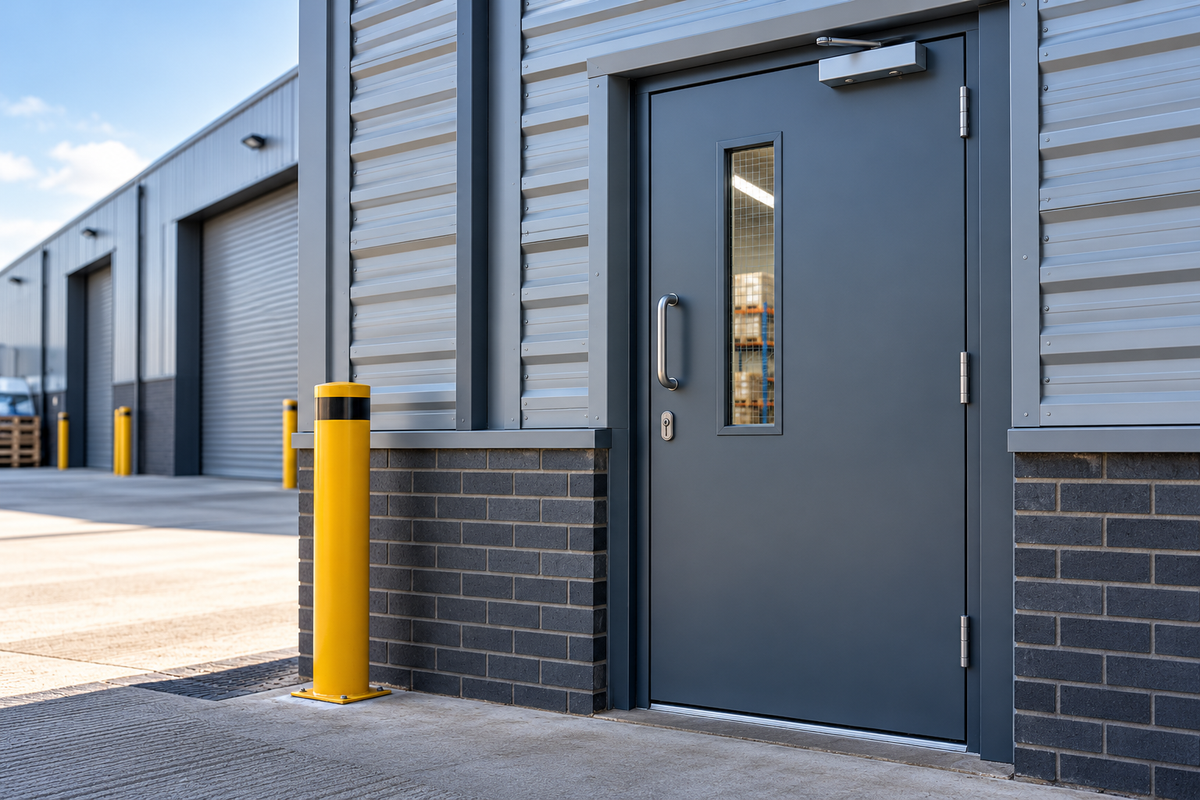
Choosing a security door for a commercial building is about much more than finding a strong-looking steel door. Warehouses, offices, schools, factories, retail premises and utility buildings can all have very different security requirements, so the right specification depends on where the door is being installed, what it needs to protect and the level of risk involved.
A standard steel door may provide a robust physical barrier, but some applications require independently tested high-security doors, while others need additional features such as fire resistance, panic escape hardware, access control, glazing or ventilation.
Understanding these differences can help you avoid over-specifying an expensive door where it isn't necessary – or, more importantly, installing a door that doesn't provide the level of protection the building actually requires.
In this guide, we'll look at the main factors to consider when choosing a commercial security door.
What Is a Commercial Security Door?
A commercial security door is designed to provide a stronger physical barrier against unauthorised access than a typical internal or external door.
Steel is widely used for commercial security doors because it offers strength, durability and considerable flexibility in how a door can be configured.
Depending on the application, a steel security door can be manufactured with different locking arrangements, hardware, glazing, ventilation and access-control options.
However, it's important to distinguish between a door that is simply manufactured from steel and a door that has been independently tested to a recognised security standard.
A steel door isn't automatically a security-rated door.
Where a particular level of burglary resistance is required, the specification should consider an independently tested and certified product rather than relying purely on the material or appearance of the door.
Start by Assessing the Security Risk
Before choosing a door, think about what you are actually trying to protect.
A door providing access to a general office storeroom is unlikely to face the same risks as an external entrance protecting valuable stock, critical equipment or infrastructure.
Consider questions such as:
- Is the door accessible from a public area?
- What would an intruder gain access to if the door were breached?
- Is valuable stock or equipment stored inside?
- Has the property previously experienced attempted break-ins?
- Is the door in an isolated or poorly monitored location?
- Is a particular security standard specified by an insurer, architect or security consultant?
The answers will help determine whether a robust general-purpose steel door is sufficient or whether a tested high-security door should be specified.
What Does LPS 1175 Mean for Security Doors?
For higher-risk applications, you may encounter doors tested to LPS 1175.
LPS 1175 is a recognised standard used to assess the resistance of security products to forced entry. Testing considers the tools and attack methods that could realistically be used by an intruder.
The standard doesn't only apply to doors. It is also used for products such as security shutters and grilles.
This provides specifiers and customers with a more meaningful way of comparing security products than simply describing a door as "heavy duty" or "high security".
The current Issue 8 classification uses a combination of a letter and number. Broadly, the letter relates to the threat/tool category used during testing and the number represents the minimum attack duration associated with the classification.
This becomes increasingly important for higher-risk commercial and industrial sites where security performance needs to be demonstrated rather than assumed.
We've explained the system in more detail in our guide to LPS 1175 Issue 7 and Issue 8 security ratings.
Standard Steel Door or High-Security Door?
Not every commercial building needs the highest security rating available.
For many everyday applications, a well-specified steel door can provide an effective and durable solution.
This might include general industrial buildings, storerooms, service areas and other locations where the primary objective is to provide a robust physical barrier.
A tested high-security steel door becomes more appropriate where the consequences of forced entry are greater or where a particular security standard has been specified.
These applications could include plant rooms, utilities, infrastructure, high-value storage areas and other sensitive premises.
Choosing the highest possible security rating isn't necessarily the objective. The better approach is to select a door with a performance level appropriate to the identified risk.
Security Door vs Fire Door: What's the Difference?
This is an important distinction.
Security resistance and fire resistance are not the same thing.
A security door is primarily designed to resist unauthorised entry and physical attack. A fire-rated door is designed and tested to provide a specified level of fire resistance as part of a building's fire-safety strategy.
A steel door shouldn't therefore be assumed to be fire rated simply because it is manufactured from steel.
Equally, a fire-rated steel door doesn't automatically provide a particular level of forced-entry resistance.
In buildings where both fire protection and security are required, the complete door specification needs to satisfy the relevant requirements for that location.
This is one reason it's worth establishing the full performance requirements before choosing a door rather than selecting the product first and attempting to adapt the specification afterwards.
Does the Security Door Need to Be an Emergency Exit?
How people use the door is just as important as how secure it needs to be.
Some security doors are intended primarily to restrict entry, while others form part of an escape route and must allow occupants to leave safely.
Depending on the application, this may involve escape hardware such as panic or emergency-exit devices.
A door should never be made more difficult to escape through simply to increase security.
Where a door forms part of an emergency escape route, the fire strategy, relevant regulations and required exit hardware should all be considered as part of the specification.
Choosing the Right Locking System
The locking arrangement can have a significant impact on both security and everyday usability.
A commercial steel security door may require conventional locking, multi-point locking or integration with an electronic access-control system, depending on its intended use.
For example, a warehouse personnel entrance may have very different requirements from a restricted plant room accessed only by authorised engineers.
Electronic access control can also be useful where a business needs greater control over who enters particular areas.
The important point is to consider the door, frame, locking system and hardware as one complete security solution, rather than concentrating on the door leaf alone.
Can Access Control Be Fitted to a Security Door?
Yes, depending on the door specification.
Commercial security doors can often be configured for access-control equipment, allowing businesses to control and monitor entry to restricted areas.
This can be particularly useful in offices, industrial buildings, data centres, warehouses and infrastructure sites where different employees or contractors require different levels of access.
If access control is required, it is best to identify this at the specification stage so that the door, locking arrangement and associated hardware can be designed appropriately.
For security-rated products, any changes also need to be considered carefully so that the certified configuration isn't inadvertently compromised.
Can Security Doors Have Windows?
Security doesn't necessarily mean installing a completely solid door.
Vision panels may be required for operational or safety reasons, particularly where staff need to see someone approaching from the opposite side of a door.
However, glazing creates another element that needs to be considered as part of the overall specification.
Where a particular security or fire performance is required, the glazing system and its installation need to be suitable for that requirement. Adding ordinary glazing to a high-security door could undermine the protection the door was selected to provide.
The same principle applies to other additions.
What About Ventilation?
Plant rooms, electrical rooms and other service areas sometimes require permanent airflow.
In these situations, a louvred steel door may be suitable.
Again, the requirement needs to be considered alongside security. A large ventilation opening can potentially create a weak point if it isn't designed as part of the overall door specification.
Rather than choosing a standard door and adding ventilation afterwards, it's better to specify the required airflow and security requirements together.
Single or Double Security Doors?
The size and use of the opening will determine whether a single or double door is more appropriate.
Single doors work well for many personnel entrances and service areas, while double doors can provide a larger clear opening for equipment, deliveries and higher-traffic environments.
The choice shouldn't be based solely on opening width. Consider how frequently the doors will be used, what needs to pass through them and whether both leaves need to operate regularly.
Internal or External Security Door?
External security doors face additional challenges.
Alongside resistance to unauthorised entry, an external door may need to withstand weather exposure and frequent use. Its finish, threshold, seals and surrounding construction therefore need careful consideration.
Internal security doors can be used to create secure zones within a larger building, protecting areas such as stockrooms, plant rooms, server rooms and restricted operational spaces.
This can form part of a layered security approach, where an intruder has to overcome several separate barriers rather than gaining unrestricted access after breaching the building perimeter.
Don't Forget the Surrounding Structure
Even an extremely strong security door can only perform properly when it is installed into a suitable opening.
The wall construction, frame and fixings are therefore important parts of the security system.
Installing a high-security door into an unsuitable surrounding structure could create a weaker route of attack around the door itself.
For higher-security applications in particular, the complete installation should follow the requirements associated with the tested product configuration.
This is also why professional surveying and installation are important when specifying security-rated products.
Which Security Door Is Right for Different Buildings?
Different buildings naturally have different priorities.
A warehouse may require robust external personnel doors alongside larger industrial access doors. A school may need to balance security with safe movement and emergency escape. A retail building may be particularly concerned about unauthorised access to stock or back-of-house areas.
Factories and industrial premises may need doors protecting machinery, plant rooms and restricted areas, while utilities and infrastructure sites may require considerably higher levels of forced-entry resistance.
There isn't therefore one "best security door" for every commercial property.
The right solution comes from matching the door specification to the application, risk and required performance.
Common Mistakes When Choosing a Security Door
One of the biggest mistakes is assuming that any heavy steel door will provide high-security performance.
Another is focusing exclusively on the door itself while overlooking the frame, locks, hardware, fixings and surrounding structure.
It's also important not to confuse fire performance with security performance or to add glazing, louvres or alternative hardware without considering whether those changes affect the required certification.
Finally, avoid automatically specifying the highest possible security level. Higher-security products are designed for particular risks and attack scenarios. A properly assessed and proportionate specification is usually the better approach.
How to Specify a Commercial Security Door
Before requesting a quotation, gather as much information as possible about the opening and its intended use.
Useful information includes the approximate opening dimensions, wall construction, whether the door is internal or external, required security level, fire-rating requirements, access-control requirements, emergency-exit requirements, glazing or ventilation needs and preferred finish.
If you're unsure about the security rating required, speak to your insurer, architect, security consultant or door supplier before finalising the specification.
Getting these details right at the beginning can make the quotation and specification process considerably easier.
Frequently Asked Questions About Security Doors
Are steel doors more secure than wooden doors?
Steel provides a strong and durable material for commercial doors, but the material alone doesn't determine the door's security performance. For applications requiring a defined level of forced-entry resistance, look for a complete doorset that has been tested and certified to an appropriate security standard.
What is an LPS 1175 security door?
An LPS 1175 security door is a doorset that has been tested and certified against defined forced-entry attack requirements under the LPS 1175 standard. Different classifications represent different attack scenarios and resistance periods.
Is every steel door security rated?
No. A door can be manufactured from steel without having an independently tested security rating. If a particular security classification is required, check the certification for the complete product.
Can a security door also be fire rated?
Potentially, but the two properties should be verified separately. Security resistance and fire resistance are different performance characteristics, so don't assume that a security-rated door is automatically fire rated or vice versa.
Can you fit access control to a security door?
Access-control systems can be incorporated into many commercial security doors. If you're specifying a security-rated product, however, the hardware and configuration should be appropriate to the tested and certified doorset.
Can security doors have glass panels?
Some security doors can incorporate vision panels. Where a particular security or fire rating is required, the glazing and its fixing system need to be compatible with that performance requirement.
What security rating does my business need?
That depends on the risks associated with the property, the value or importance of what is being protected and any requirements imposed by insurers or project specifications. Higher ratings aren't automatically necessary for every commercial building.
Should security doors be professionally installed?
Professional installation is particularly important for security-rated doors. The performance of the complete system depends on the door, frame, hardware, fixings and surrounding structure working together as intended.
Choosing the Right Commercial Security Door
Choosing a commercial security door isn't simply a question of how thick or heavy the door looks.
The best specification considers the level of security required, how the building is used, whether fire resistance or emergency escape is needed, and whether the door requires features such as access control, glazing or ventilation.
For higher-risk applications, independently tested products such as LPS 1175 security doors can provide evidence of how the product performs against defined forced-entry attacks.
Security Direct can help you assess your opening and identify an appropriate steel-door solution for your building, whether you're securing a warehouse, school, office, industrial premises or higher-risk site.
Need help choosing a security door? Contact Security Direct with your opening dimensions and requirements, and our team can help you identify a suitable solution.
You can also read feedback from previous Security Direct customers through our Feefo reviews and Trustpilot reviews before making your decision.


