
Choosing the right door for your building is about much more than appearance. For commercial properties, schools, warehouses and industrial premises, the right entrance can play a significant role in protecting people, assets and operations.
While standard entrance doors are suitable for many applications, businesses with higher security requirements often choose steel security doors to provide enhanced protection against forced entry, vandalism and unauthorised access.
In this guide, we'll compare security doors and standard entrance doors, helping you understand which solution is best suited to your property.
An entrance door is typically the primary access point into a building. It serves both a functional and aesthetic purpose, providing access while contributing to the overall appearance of the property.
Entrance doors are available in a variety of materials, including:
Many commercial buildings use entrance doors designed primarily for appearance, accessibility and day-to-day use rather than high-security protection.
While these systems can be perfectly adequate for some environments, they may not offer the level of resistance required for higher-risk locations.
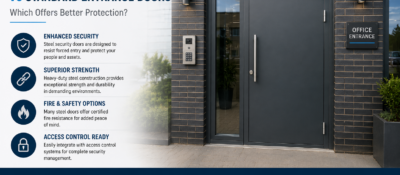
A security door is specifically engineered to provide enhanced protection against forced entry, attack and vandalism.
Unlike standard entrance doors, security doors incorporate reinforced materials, specialist locking systems and robust construction methods designed to resist intrusion.
Common features include:
Security doors are commonly installed in commercial, industrial and public sector buildings where protecting people and assets is a priority.
Steel doors have become one of the most popular security solutions for commercial premises.
Their combination of strength, durability and long-term reliability makes them suitable for a wide range of environments.
Exceptional Strength
Steel is significantly stronger than many traditional door materials, making it far more resistant to physical attack and forced entry.
Long Service Life
Properly manufactured steel doors are designed to withstand years of daily use, even in demanding environments.
Low Maintenance
Unlike timber doors, steel doors require minimal maintenance and are less susceptible to warping, cracking or weather-related deterioration.
Enhanced Security
Combined with high-performance locking systems, a steel door provides a substantial physical barrier that helps deter criminal activity.
Security doors are specifically designed to resist attack, while standard entrance doors often prioritise appearance and accessibility.
For businesses storing valuable stock, equipment or sensitive information, this additional protection can be invaluable.
A metal door is generally more durable than many traditional door materials, particularly in high-traffic environments.
Commercial properties with frequent daily use often benefit from the long-term reliability offered by steel construction.
Security doors typically require less maintenance over their lifespan due to their robust construction and weather-resistant finishes.
Although security doors may require a higher initial investment, they often deliver greater long-term value through:
Security doors are used throughout a wide range of sectors.
Common applications include:
Commercial Buildings
Protecting offices, retail units and business premises from unauthorised access.
Warehouses and Industrial Facilities
Securing stock, equipment and operational areas.
Schools and Educational Buildings
Providing controlled access to sensitive areas.
Healthcare Facilities
Protecting staff, equipment and restricted locations.
Public Sector Buildings
Enhancing security while maintaining accessibility.
Today's steel security doors offer much more than basic protection.
Depending on the specification, systems can also provide:
Fire Protection
Many steel doors are available with certified fire-resistant ratings.
Acoustic Performance
Certain door systems help reduce noise transfer between internal and external environments.
Thermal Efficiency
Modern insulated steel doors can contribute to improved energy efficiency.
Access Control Compatibility
Security doors can be integrated with:
When selecting between a standard entrance door and a security door, consider:
A professional site survey can help identify the most suitable solution based on your operational and security needs.
For over 30 years, Security Direct has supplied and installed high-quality security doors, steel doors and commercial entrance doors throughout the UK.
Our experienced team works with businesses, schools, healthcare providers and industrial operators to deliver door solutions that combine security, durability and professional appearance.
Don't just take our word for it, visit our Feefo Reviews and Trustpilot pages to see what our customers have to say.
In most cases, yes. Steel doors provide significantly greater resistance to forced entry and physical attack.
A security door is specifically designed to resist intrusion, while an entrance door is generally designed primarily for access and appearance.
Yes. Metal doors are widely used in commercial and industrial environments due to their strength, durability and low maintenance requirements.
Absolutely. Many modern security doors can be integrated with electronic access control technologies.
With proper installation and maintenance, steel security doors can provide many years of reliable service.
If you're considering upgrading your building's security, Security Direct can help.
Contact our team today for expert advice, a free site survey and a no-obligation quotation for steel security doors tailored to your property and operational requirements.
Learn the differences between steel security doors and standard entrance doors. Discover which optio...
Discover how window roller shutters improve security, privacy and energy efficiency for homes and co...
Discover how a busy distribution warehouse improved efficiency, security and workflow with the insta...