
Fire roller shutters are widely used to protect serving hatches between kitchens and occupied spaces in schools, care homes, community centres, and commercial buildings. On paper, the solution appears straightforward: fit a fire-rated shutter over the opening and rely on it to contain fire and hot gases if an incident occurs.
However, recent industry guidance has highlighted a critical compliance issue: a fire shutter tested and certified to close to finished floor level (FFL) may not automatically be certified for installation over a servery hatch where it closes onto a countertop.
The Door & Hardware Federation (dhf) has addressed industry concerns following certification audits, stating that some certification bodies have concluded that their existing certification does not cover shutters that do not close to the floor — such as those used on serveries — unless additional testing and certification has been obtained
For building owners, designers, and installers, this is not a minor technicality. It goes directly to product scope, Declaration of Performance (DoP), CE/UKCA marking, and legal risk.
This guide explains:
The document titled “dhf guidance on servery” responds directly to concerns about fire-rated roller shutters installed over serving hatches.
The key statement driving the controversy is:
The implication is clear: a shutter tested to floor level cannot automatically be assumed compliant when installed to close onto a countertop.
This issue is not purely administrative. It is rooted in how fire resistance testing works.
Under EN 1363-1, fire resistance tests are conducted in a furnace where pressure varies vertically. Accredited test reports commonly reference:
Control conditions equating to around 20 Pa at the head of the assembly
The closure line is below or near the neutral plane.
From a fire integrity perspective, that change is significant.
The dhf position is that current standards do not include an extended application rule that allows this variation without direct test evidence.
Fire-resisting roller shutters placed on the UK market under designated standards generally require:
The dhf guidance states that without relevant certification for the specific configuration, a manufacturer cannot legitimately CE/UKCA mark or issue a DoP covering that use.
This creates a potential compliance gap where:
If a fire strategy depends on that shutter for compartmentation, this becomes more than paperwork — it becomes a liability exposure.
Industry response indicates a split in approach:
1. Floor-Level (FFL) Certified Shutters
Some manufacturers recommend installation only to finished floor level, aligning strictly with tested configurations and EXAP scope.
2. Servery-Specific Variants
Other manufacturers now offer separate “servery hatch” variants backed by:
This suggests the issue is recognised as technically material rather than theoretical.
If you are specifying, installing, or maintaining a fire shutter over a servery, request the following:
1. Declaration of Performance (DoP)
Confirm it covers the product supplied — not a generic family document.
2. CE/UKCA Marking
Check labelling matches certification documentation.
3. Fire Test Report
Verify:
4. Classification Report (EN 13501-2)
Confirm achieved rating (E, EW, EI) and scope limitations.
5. Extended Application (EN 15269-10) Documentation
Check whether raised closure lines are explicitly permitted.
6. Installation Instructions
These should define:
If this documentation cannot demonstrate countertop closure is within scope, you have a risk exposure.
This situation is common, particularly in older buildings.
Recommended approach:
Do not ignore the issue. Fire risk assessments increasingly flag missing evidence for serving hatch protection.
If designing a new servery installation:
From an operational perspective, this avoids incomplete installs, disputes, and later compliance questions — especially where Building Control or insurers request evidence.
A fire roller shutter over a servery hatch is not automatically equivalent to one tested closing to the floor.
The dhf guidance makes clear that, under current standards, certification bodies may not consider raised bottom-rail configurations within scope unless separately tested and certified
For building owners and duty-holders, the key principle is simple:
Match the installed configuration to the certified configuration — and be able to prove it.
If the evidence chain does not explicitly cover a countertop closure line, you should assume there is a compliance gap until proven otherwise.
If you are specifying or reviewing a fire shutter over a serving hatch and want to confirm compliance:
Contact Security Direct for advice or a quote for a new Servery Fire Shutter. We can assess:
And provide clear, practical recommendations to reduce compliance risk.
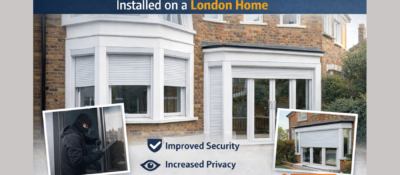
Discover how domestic roller shutters improved security, privacy and energy efficiency for a London ...

Discover how window roller shutters improved security, reduced glare and enhanced energy efficiency ...
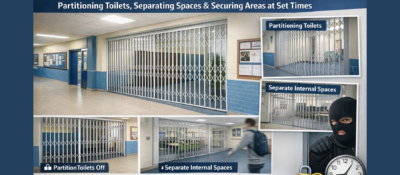
Discover how retractable security grilles helped a school partition toilet areas, separate internal ...